


By Jabulani Simplisio Chibaya

HARARE – ECONET Wireless Zimbabwe has unveiled what is arguably the most consequential corporate restructuring in the country’s modern capital markets history: a voluntary delisting from the Zimbabwe Stock Exchange (ZSE), a US$0.50 per share exit offer, and the simultaneous listing of a newly carved-out infrastructure platform, Econet InfraCo on the Victoria Falls Stock Exchange (VFEX).
Behind the mechanics lies something far more strategic than a simple delisting. This is a deliberate capital markets re-engineering, a separation of assets, valuation philosophies and investor bases aimed at correcting what the board describes as a persistent and structural market mispricing of the business.

The Offer at the Centre of the Storm
At the core of the circular is a single, indivisible exit offer of US$0.50 per Econet share, structured as:
- US$0.17 in cash, and
- US$0.33 in Econet InfraCo shares, issued on a one-for-one basis for every Econet share tendered.
The cash component represents Econet’s implied market value derived from the 90-day volume weighted average price (VWAP) prior to the first cautionary announcement on 3 December 2025. That VWAP stood at approximately US$0.17, implying a total equity market capitalisation of roughly US$507 million across 2,992,163,203 shares in issue.
The share component reflects an independently determined valuation of Econet InfraCo at approximately US$1.0 billion, equating to US$0.33 per InfraCo share, also based on the same 2.99 billion shares in issue.
Together, the offer values Econet at roughly US$1.5 billion in combined implied equity value, a significant departure from its prevailing ZSE market capitalisation.
A Premium That Is Hard to Ignore
Measured against recent trading levels, the offer represents a dramatic premium.
The US$0.50 exit price reflects:
- 152% premium to the 30-day VWAP,
- 187% premium to the 60-day VWAP,
- 192% premium to the 90-day VWAP, and
- Up to 400% above selected monthly trading prices during 2025.
For context, voluntary delistings on the Johannesburg Stock Exchange typically carry premiums between 20% and 80%. By regional standards, Econet’s offer is unusually generous.
Yet the circular subtly acknowledges a paradox: even at US$0.50, the board suggests shareholders are exiting at a marginal discount to what it believes is a more appropriate intrinsic value.
The Valuation Disconnect: 1.4x vs 4.9x EBITDA
The board’s central thesis rests on a valuation gap.
Econet generated approximately US$359.6 million in EBITDA for FY2025. Based on the ZSE-implied enterprise value of roughly US$509 million and modest net debt, the company was effectively trading at around 1.4x EV/EBITDA.
By comparison, African telecom peers trade materially higher:
- MTN Group: ~4.7x EV/EBITDA
- Vodacom: ~6.0x EV/EBITDA
- Weighted peer average: ~5.3x
After adjusting for Zimbabwe’s country risk premium differential (11.66% versus South Africa’s 3.90%), the board applies an adjusted multiple of 4.91x EV/EBITDA to Econet’s earnings.
That implies:
- Enterprise value: ~US$1.77 billion
- Equity value: ~US$1.78 billion
- Implied fair value per share: ~US$0.59
Against that benchmark, the US$0.50 exit price is positioned as certified “fair and reasonable” but not excessive.
The implication is clear: the board believes the market has structurally undervalued Econet.
Why the Market May Not Be at Fault
The circular does not blame deteriorating fundamentals. Instead, it points to structural capital market constraints:
- Reduced foreign participation
- Constrained institutional liquidity
- Low daily trading volumes
- Impaired price discovery
Under such conditions, raising new equity at market prices would be dilutive and value-destructive. Long-term capital investments in network infrastructure are not reflected in short-term trading prices.
In short, Econet argues that liquidity constraints, not business weakness, have suppressed valuation.
The Infrastructure Arbitrage
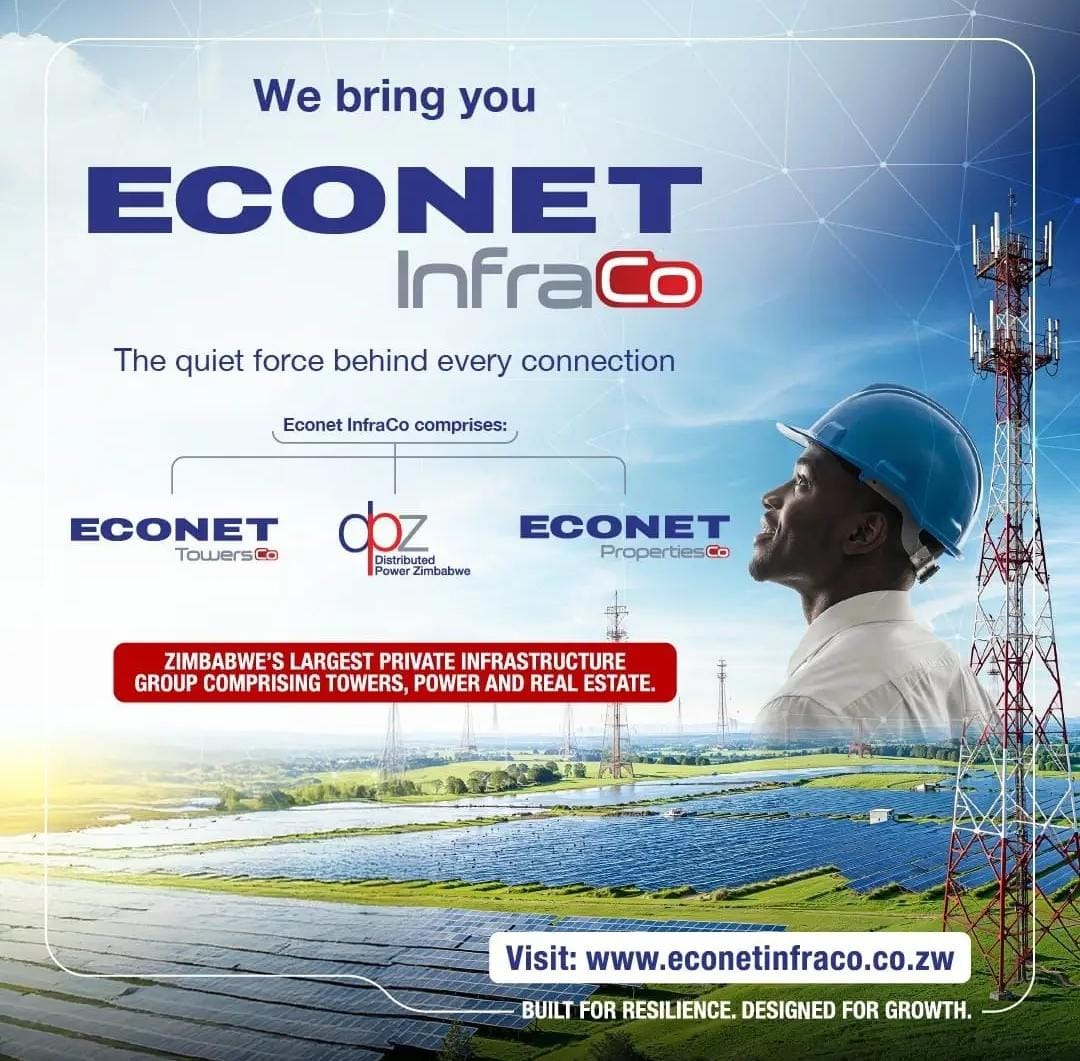
The more intriguing element of the transaction lies in the carve-out of Econet InfraCo.
InfraCo will house:
- Real estate assets (immovable property and sites)
- Passive telecommunications infrastructure (tower structures)
- Renewable energy and power systems
These assets are long-lived, capital-intensive and underpinned by long-term USD-denominated lease agreements with Econet as anchor tenant.
InfraCo’s forecast EBITDA stands at approximately US$50.4 million. Applying an implied 20x EV/EBITDA multiple, consistent with Zimbabwe-listed property companies (weighted average ~20.69x), yields an enterprise valuation of approximately US$1.0 billion.
That multiple is nearly four times higher than the telecom multiple applied to Econet on the ZSE.
This is the essence of the strategy: assets embedded inside an integrated telecom operator were being valued at telecom multiples. Once separated, they attract infrastructure-style valuation metrics.
Post-Transaction Structure: Two Different Investment Cases
If shareholders approve the special resolution requiring a 75% majority of votes cast, excluding certain related shareholders the structure becomes:
Econet (Unlisted Public Company):
- Retains active network infrastructure
- Spectrum utilisation
- Customer-facing platforms
- Digital services
- Continues as a public company under Zimbabwe law
- Shares trade OTC via VFEX platform, subject to a floor price
The board has indicated that within 12 months of delisting, and subject to solvency, the company may repurchase up to 10% of its issued shares at US$0.50.
Econet InfraCo (VFEX Listed):
- Approximately 30% public shareholding
- USD-denominated trading environment
- Infrastructure and real asset profile
- Potentially stronger alignment with asset-backed valuation models
If the 30% public float threshold is not met via the exit offer, Econet will distribute additional InfraCo shares via dividend in specie to ensure compliance.
What Investors Must Consider
The transaction is not risk-free.
Remaining shareholders in Econet will hold shares in an unlisted public company. While governance and audited financial reporting continue, liquidity becomes dependent on OTC mechanisms rather than exchange trading.
InfraCo, meanwhile, relies heavily on anchor-tenant economics. Its revenue stability depends substantially on Econet’s own operational health and long-term lease agreements.
There is also valuation risk. A 20x EBITDA multiple assumes stable cash flows, regulatory continuity and sustained investor appetite for USD infrastructure assets on the VFEX.
Tax implications further complicate the picture:
- 1% capital gains tax on exit consideration
- 10% withholding tax on dividend in specie, settled in cash by the company with equivalent shares retained as treasury stock
Strategic Implications Beyond Econet
This restructuring may signal a turning point for Zimbabwe’s capital markets.
It raises difficult questions about whether the ZSE can adequately value capital-intensive infrastructure companies in a constrained liquidity environment. It also elevates the VFEX as a potential platform for USD-denominated asset-backed issuers.
For Econet itself, the move strengthens balance sheet optics, potentially improves vendor credit access, and clarifies capital allocation between growth telecom operations and long-duration infrastructure assets.
For customers and the broader economy, infrastructure separation could enhance operational resilience and allow more focused reinvestment in network quality and digital services.
The Decision Before Shareholders
The extraordinary general meeting scheduled for 26 February 2026 will determine the outcome.
Shareholders face a binary choice:
Exit at US$0.50 per share, crystallising a substantial premium to historical market prices, or remain invested in a newly structured ecosystem where value discovery shifts from exchange liquidity to asset economics.
The numbers are clear. The premiums are compelling. The valuation argument is coherent.
But ultimately, this is more than a financial transaction. It is a strategic repositioning of Zimbabwe’s largest telecom operator and potentially a blueprint for how value is unlocked in markets where liquidity no longer tells the full story.
If approved, Econet’s delisting will not merely remove a ticker from the ZSE. It will redraw the map of how infrastructure, telecom operations and capital markets intersect in Zimbabwe.
A LANDMARK MOMENT
Few corporate actions in Zimbabwe have attempted to solve such a large and entrenched valuation problem so directly. Econet’s move challenges long-held assumptions about listings, liquidity and the role of local exchanges in pricing national champions.
At its core, the transaction asks shareholders a simple but profound question:
Do you value immediate liquidity, or long-term intrinsic value?
The answer will not only shape Econet’s future, but may also influence how other large corporates think about capital markets, structure and value creation.
THE EXIT OFFER, IN SUMMARY
- Price: US$0.50 per Econet share
- Cash: US$0.17 per share
- InfraCo equity: US$0.33 per share (1:1)
- InfraCo implied valuation: ~US$1.0 billion
- Econet implied fair value: ~US$1.78 billion
- Key metric: EV/EBITDA reset from ~1.4x to ~4.9x
This is not merely a delisting.
It is one of the most ambitious value-unlocking exercises ever attempted in Zimbabwe.
Jabulani Simplisio Chibaya is a Data and AI Consultant specializing in data science, artificial intelligence, blockchain, and cryptocurrency innovation. A seasoned conference speaker, he also writes on the intersection of technology, regulation, and economic development. Contact: Cell: +263 778 921 881, Email: simplisiochibaya22@gmail.com, LinkedIn: https://www.linkedin.com/in/jabulani-simplisio-chibaya

Discover more from Etimes
Subscribe to get the latest posts sent to your email.