


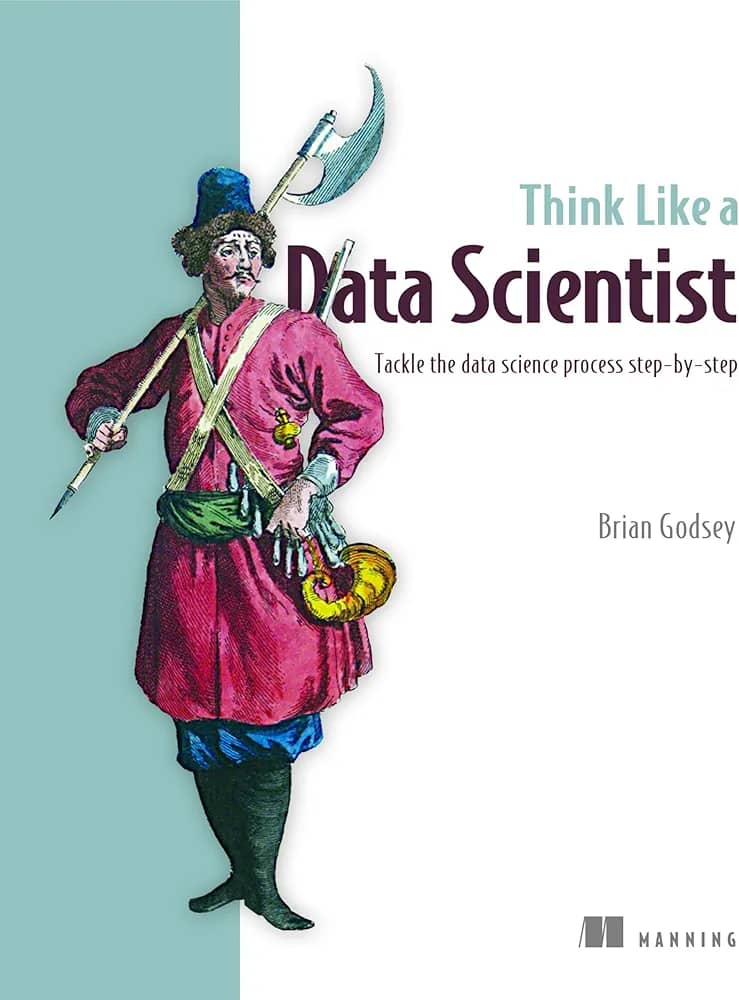
The Book That Met Me at the Right Time

By Jabulani Simplisio Chibaya
HARARE – THERE are books you read for information, and then there are books you encounter at the exact moment your questions become uncomfortable enough to demand better answers. Think Like a Data Scientist by Brian Godsey was the latter for me.

I first encountered this book at the early stages of my journey into data science and artificial intelligence in 2017, a time marked by excitement, confusion, and relentless self‑education. Like many entering the field, I was surrounded by conversations about tools, programming languages, and algorithms. Yet something felt incomplete. I could learn Python. I could follow tutorials. But I still lacked a mental framework for why I was doing what I was doing.
Godsey’s book did not merely explain data science; it reframed it. It presented data science not as a technical career, but as a disciplined way of thinking under uncertainty. That idea stayed with me and continues to shape how I approach learning, teaching, and building data capacity, particularly in emerging contexts like Zimbabwe.
This article is both a review of Godsey’s work and a reflection on what data science has become: a modern craft, a critical career path, and a curiosity‑driven discipline that increasingly defines how societies make decisions.
Why Data Science Keeps Calling Us
People ask about data science not because it is trendy, but because it has quietly embedded itself into nearly every consequential decision of our time. Businesses allocate capital with it. Governments plan policy around it. Scientists validate theories through it. Even everyday digital experiences—from mobile money to social media, are shaped by unseen data‑driven reasoning.
Godsey argues that data science is misunderstood precisely because we focus on its outputs rather than its thinking. Dashboards, models, and AI systems are visible. The intellectual discipline that produces them is not. His book insists that before one learns how to code or model, one must learn how to think scientifically with data.
This distinction explains both the power and the frustration surrounding the field. Data science promises clarity, yet often delivers confusion, because clarity cannot be automated. It must be reasoned.
What Data Science Really Is
At its core, Godsey defines data science as the application of the scientific method to data‑centric problems. This is a deceptively simple definition with profound implications.
Data science does not begin with data. It begins with a problem – often vague, messy, and poorly articulated. Only after clarifying the problem does the data scientist evaluate what data exists, what is missing, what assumptions are being made, and what uncertainty must be tolerated.
In this framing, algorithms are tools, not solutions. Models are hypotheses, not truths. The real work lies in judgment: knowing what questions to ask, what evidence is sufficient, and when results should not be trusted.
Godsey repeatedly returns to one central idea: awareness. Awareness of uncertainty. Awareness of bias. Awareness of the limits of data. Without this, data science degenerates into confident nonsense.
Data Science as a Process, Not a Job Title
One of the book’s most valuable contributions is its clear articulation of the data science lifecycle. Godsey divides the work into three interdependent phases:
Preparation is where most projects succeed or fail. Goals are clarified, questions refined, and data explored. This phase demands humility—accepting that the initial understanding is likely wrong.
Building is where analysis, modeling, experimentation, and iteration occur. Here, statistical reasoning meets software engineering, but always in service of the original question.
Finishing is where many teams stumble. Results must be communicated, decisions documented, feedback incorporated, and work made reproducible. A model that cannot be explained or reused is unfinished work.
This lifecycle reveals a critical truth: data science is not about speed. It is about learning deliberately through uncertainty.
Why Data Science Emerged at All
Godsey situates data science historically. Modern systems generate data at a scale never seen before, but data alone carries no meaning. Spreadsheets do not answer questions. Databases do not make decisions.
Data science exists because humans need help converting raw information into justified action. Its role is not only to extract insights, but to determine which questions are worth asking in the first place.
In this sense, data science is as much about restraint as it is about discovery. Knowing what not to conclude is often more valuable than producing impressive‑looking results.
Data Science as a Career: Many Roles, One Mindset
A persistent myth is that data science is a single job. Godsey dismantles this idea by focusing on responsibility rather than title.
Some practitioners focus on descriptive analysis. Others on statistical inference. Others build the infrastructure that enables data work at scale. What unites them is a shared commitment to evidence‑based reasoning under uncertainty.
Godsey draws a sharp contrast with traditional software development. Software engineers work in environments of certainty—systems either function or they fail. Data scientists work in probabilities. Their outputs are never absolute, only more or less justified.
Communicating this uncertainty is not a weakness of the profession; it is its defining strength.
Pivoting into Data Science: A Realistic Path
One of the most encouraging insights from Think Like a Data Scientist is that there is no single academic gateway into the field. Godsey himself transitioned from mathematics and statistics into applied data science across domains.
He argues that domain knowledge can be learned. Tools can be learned. What is harder—and more valuable—is learning how to:
Ask precise, testable questions
Judge whether data is relevant and sufficient
Recognize inconclusive results
Revise goals when evidence contradicts expectations
These habits define a data scientist far more than any specific programming language.
Preparing at A‑Level: What Students Really Need
For students at A‑Level aspiring to degrees in data science, computer science, AI, or related fields, Godsey’s philosophy offers clarity.
Strong foundations in mathematics, statistics, and logical reasoning matter more than early specialization in tools. Subjects such as Mathematics, Further Mathematics, Computer Science, Economics, and even the natural sciences cultivate the mental discipline required for data work.
Equally important is learning how to explain reasoning clearly—in writing and speech. Data science ultimately lives or dies by communication.
Data Science Inside Organisations
Godsey is firm: data science must never exist in isolation. Its value emerges only when embedded within real decision‑making.
Marketing uses it to understand behavior. Finance uses it to manage risk. Operations use it to optimize systems. Policy institutions use it to evaluate impact. Across all these contexts, the role of data science is consistent—to reduce uncertainty responsibly.
This requires close collaboration between data scientists, domain experts, and leadership.
Building Data Science Departments and Centres of Excellence in Zimbabwe
In the Zimbabwean context, this insight is critical. Data science teams cannot be built by copying Silicon Valley job titles or purchasing expensive software.
A sustainable data science function must begin with national and organisational priorities: financial inclusion, agriculture, energy, health, education, governance, and infrastructure.
Centres of Excellence should:
Start with clearly defined problems, not tools
Invest in data quality and governance
Train multidisciplinary teams
Document processes rigorously
Build ethical and legal awareness around data use
In resource‑constrained environments, disciplined thinking is a competitive advantage.
Continuous Learning as a Professional Obligation
Godsey devotes significant attention to what happens after delivery. Feedback, review, and reflection are not optional—they are core to the discipline.
Just as models must be retrained, data scientists must continually refine their thinking. In this sense, data science is inseparable from continuous personal development—a lesson that resonated deeply with my own journey.
Curiosity, Disciplined
The quiet heartbeat of Think Like a Data Scientist is curiosity—tempered by discipline. Godsey portrays data scientists as explorers, navigating uncertainty carefully rather than recklessly.
Without curiosity, the field becomes mechanical. Without discipline, it becomes dangerous. Excellence lies in holding both.
Final Reflections
Think Like a Data Scientist is not a manual for mastering tools. It is a guide to mastering judgment.
In a world increasingly shaped by data and AI, this way of thinking is no longer optional. It is a modern literacy. For students choosing subjects, professionals pivoting careers, and institutions building capacity—especially in Zimbabwe—the message is clear:
Learn to ask better questions. Respect uncertainty. Stay curious. And let evidence, not ego, guide decisions.
Jabulani Simplisio Chibaya is a Data and AI Consultant specializing in data science, artificial intelligence, blockchain, and cryptocurrency innovation. A seasoned conference speaker, he also writes on the intersection of technology, regulation, and economic development. Contact: Cell: +263 778 921 881, Email: simplisiochibaya22@gmail.com, LinkedIn: https://www.linkedin.com/in/jabulani-simplisio-chibaya
Discover more from Etimes
Subscribe to get the latest posts sent to your email.