


By Jabulani Simplisio Chibaya
HARARE – THERE comes a decisive phase in the life of every junior miner when narrative must give way to numbers. Exploration headlines must mature into production schedules. Geological models must convert into grade control, throughput, recoveries — and ultimately, free cash flow.
For Kavango Resources Plc, listed on the Victoria Falls Stock Exchange, that inflection point is no longer theoretical. It is operational.

At approximately US¢3.80 — up more than 120% over the past 12 months and trading near its 52-week highs — the market is no longer valuing Kavango as a speculative explorer. It is pricing in transition. The rerating reflects anticipation that 2025–2026 will mark the company’s evolution into a structured gold producer with embedded copper optionality.
The central question is no longer geological potential. It is execution velocity.
The Re-Rating: From Story Stock to Transition Asset
The transformation narrative rests on a dual-asset strategy:
- Near-term gold production in Zimbabwe
- District-scale copper exploration in Botswana
This is a deliberate capital architecture.
Gold provides potential cash generation in a high-price environment, supported by central bank buying and geopolitical hedging demand. Copper represents long-duration exposure to electrification, EV build-out, and grid expansion.
With a market capitalisation north of US$100 million against FY2024 revenue of roughly US$445,000 and a loss before tax of US$8.66 million, traditional valuation metrics appear stretched. But junior mining rarely trades on trailing revenue.
It trades on forward inflection.
And the market is positioning for that.
Zimbabwe Gold: Mechanisation as Margin Strategy
At Hillside and Nara, Kavango has consolidated historical artisanal workings into mechanised operations. The technical disclosures across 2025 updates highlight:
Structurally controlled gold mineralisation
Confirmation of gold-bearing zones through historical workings
Centralised processing and grade control improvements
Transition toward higher throughput and improved recoveries
The deeper implication is operational standardisation. Artisanal goldfields demonstrate mineral presence but lack consistency. Mechanisation introduces repeatability — and repeatability is what financial markets reward.
The strategic objective is clear:
Absorb fixed costs through scale.
Improve recovery rates.
Reduce unit costs per ounce.
Move toward breakeven — and beyond.
If quarterly reports begin showing steady ounce growth with stable or declining all-in sustaining costs, valuation support strengthens materially. If production volatility persists, the rerating could stall.
Gold is the cash engine. It must stabilise first.
Botswana Copper: The Strategic Multiplier
Kavango holds one of the largest independent land packages in the Kalahari Copper Belt — a rapidly emerging copper district.
Technical updates during 2025–2026 have referenced:
Airborne geophysics and structural modelling
Identification of conductive targets
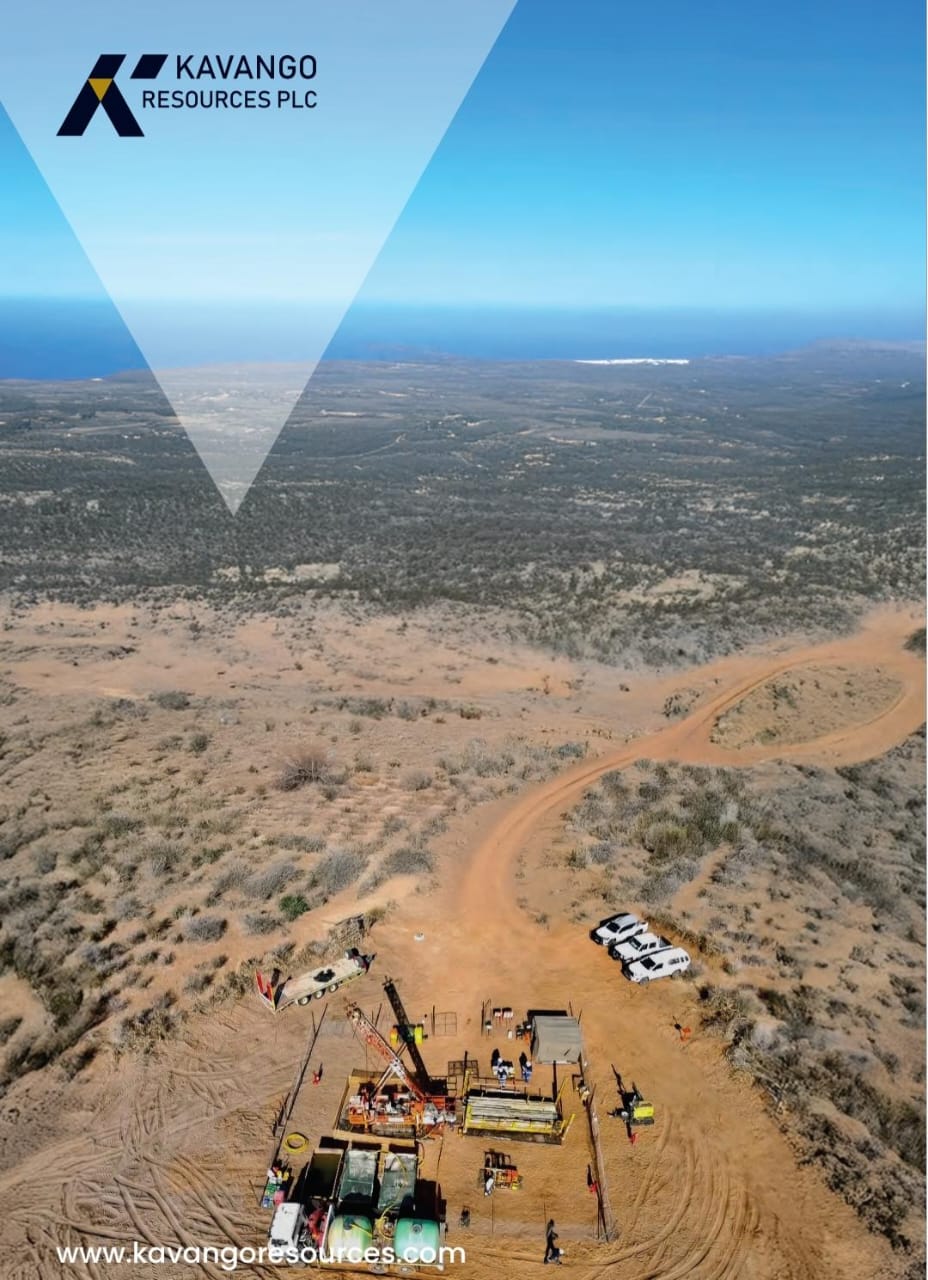
Systematic drilling campaigns targeting sediment-hosted copper systems
Interpretation aligned with Tier-1 deposit architecture
This is not incremental exploration. It is district-scale targeting.
Copper sits at the heart of global electrification — from renewable grids to EV infrastructure and data centre expansion. Supply deficits are increasingly discussed across commodity markets. A commercially viable copper discovery would fundamentally alter Kavango’s valuation structure.
Gold sustains.
Copper transforms.
That asymmetry is the embedded leverage.
But until drill intercepts demonstrate continuity, grade, and scale, copper remains optionality rather than bankable value.
Financial Architecture: Capital Intensity and Burn Discipline
The FY2024 financial statements underline the structural reality of junior mining:
~US$3.98 million exploration expenditure
~US$2.74 million exploration asset impairment
~US$1.1 million year-end cash
Workforce expansion from 43 to 107 employees
Losses widened not due to failure, but due to acceleration. The impairment charges likely reflect portfolio pruning — eliminating weaker licences to focus on priority targets.
The more pressing issue is liquidity runway.
With modest cash relative to annual burn, continued funding will be required unless gold production materially improves operating cash flow.
Funding pathways include:
Equity raises (dilution risk)
Strategic partnerships or JV structures
Offtake-linked financing
Production-backed debt facilities
Dilution is not inherently destructive — provided capital deployed increases asset value per share. The measure that matters is capital efficiency: dollars spent per ounce defined or per pound of copper delineated.
Liquidity Dynamics: A Thin but Responsive Market
Trading data suggests:
Low average daily liquidity
Limited institutional depth
Price strength occurring in a thin environment
Thin liquidity amplifies both upside and downside. In illiquid frontier exchanges, reratings can be sharp once institutions accumulate following milestone delivery.
Conversely, delays or funding uncertainty can trigger outsized corrections.
This is a conviction-driven register.
Strategic Messaging: Operational Readiness Over Promotion
Across 2025–2026 investor communications, management messaging converges around:
Transition from explorer to producer
Emphasis on near-term free cash flow
Capital discipline
ESG positioning, including local employment and renewable integration
The workforce composition — weighted toward technical and operational roles — signals activity on the ground rather than passive licence holding.
This is not a land bank story. It is an operational build-out story.
Markets will now judge timelines.
Macro Tailwinds: Timing Is Not Hostile
Several external factors align favourably:
Structurally supported gold pricing amid geopolitical risk
Rising long-term copper demand projections
USD-denominated listing on VFEX reducing currency volatility for international investors
Zimbabwe’s push to position VFEX as a foreign-capital-friendly exchange
The macro environment is not exuberant — but it is supportive.
Where Narrative Must Become Numbers
At current valuation levels, investors are implicitly expecting:
Measurable gold production growth
Reduction in operating losses
Clear pathway to cash flow breakeven
Continued copper drilling momentum
Resource definition upgrades
The next catalysts that could materially move the stock include:
Quarterly production updates showing consistent ounce growth
Transparent reporting of cost per ounce trends
Defined resource statements with grade clarity
High-grade copper intercept confirmations
Narratives attract capital. Delivery retains it.
Risk Surface: The Variables That Matter
Frontier mining equities are execution-sensitive. The principal risks include:
Production ramp-up delays
Funding shortfalls
Commodity price volatility
Regulatory or operational disruptions
Exploration underperformance in Botswana
High upside is inseparable from high variance.
The Inflection Point
Kavango stands between two corporate identities:
A capital-consuming exploration vehicle.
Or
A self-funding gold producer with transformational copper leverage.
The geological groundwork has been constructed.
The share price reflects anticipation.
The workforce expansion reflects operational intent.
But from here forward, valuation expansion will not be driven by presentations.
It will be driven by:
Tonnes milled.
Grades recovered.
Ounces poured.
Copper intersected.
Cash generated.
The market has expressed belief.
Now the numbers must validate it.
Jabulani Simplisio Chibaya is a Data and AI Consultant specializing in data science, artificial intelligence, blockchain, and cryptocurrency innovation. A seasoned conference speaker, he also writes on the intersection of technology, regulation, and economic development. Contact: Cell: +263 778 921 881, Email: simplisiochibaya22@gmail.com, LinkedIn: https://www.linkedin.com/in/jabulani-simplisio-chibaya
Discover more from Etimes
Subscribe to get the latest posts sent to your email.