


By Jabulani Chibaya
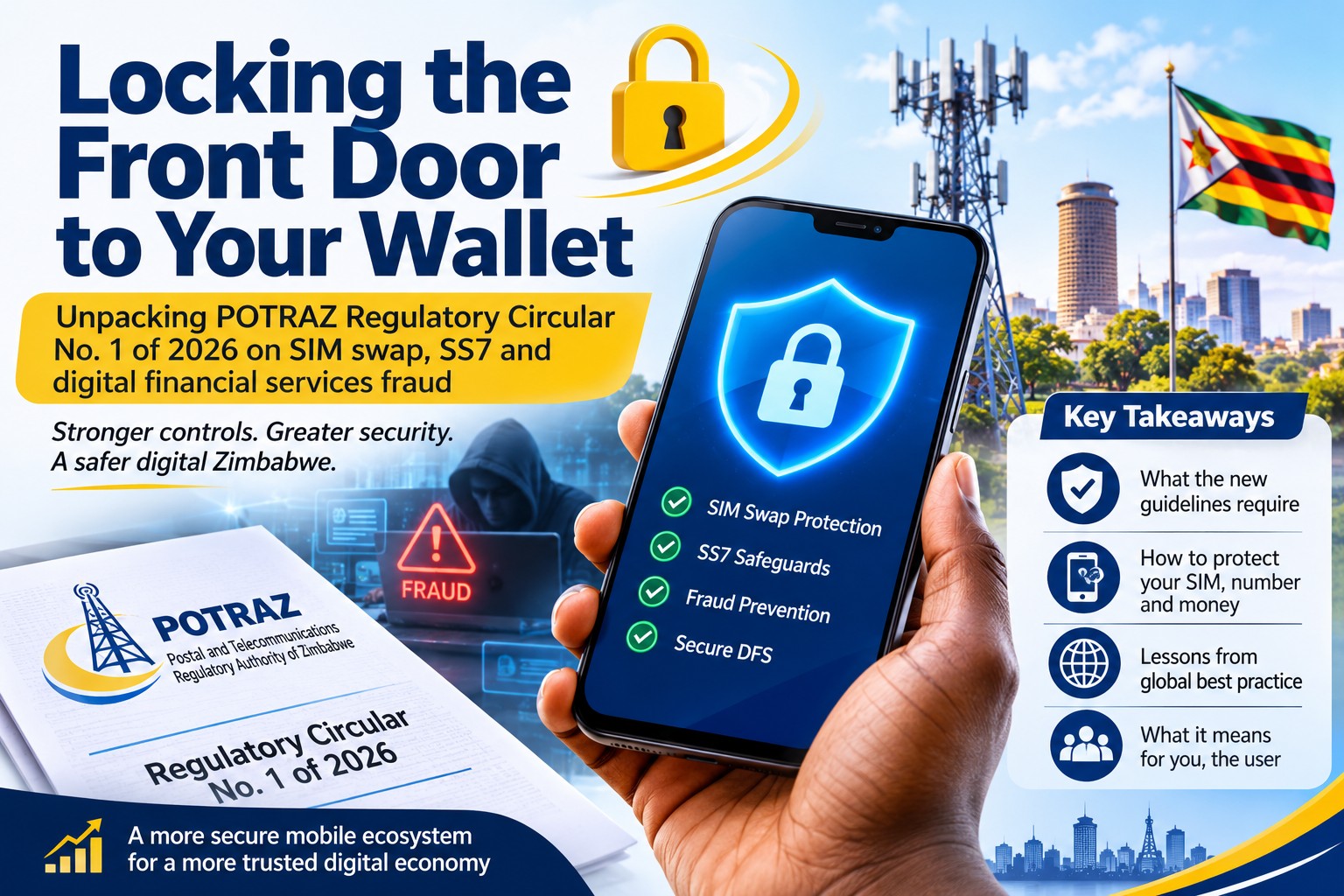
HARARE – IN Zimbabwe, your phone number has quietly become your bank account number, your password-reset channel and, often, your only proof of identity. That is why the Postal and Telecommunications Regulatory Authority of Zimbabwe (POTRAZ) published Regulatory Circular No. 1 of 2026, Security Guidelines for Mobile Network Operators to Protect Against Digital Financial Services Fraud, in The Financial Gazette of 19–25 November 2026 (pp. 12–13). The circular is dense with telecoms acronyms. This article translates them, explains what the guidelines require, weighs the implications and benchmarks them against international practice.
1. What the circular is and where its authority comes from
The guidelines set out mandatory security controls under section 18(3) of the Cyber and Data Protection Act [Chapter 12:07], read with its regulations. They bind Mobile Network Operators (MNOs), Mobile Virtual Network Operators (MVNOs) and signalling hub or gateway providers. The regulator’s starting point is blunt: mobile phones are no longer just communication tools. They are “vital gateways” to financial accounts and are often the sole point of access to a user’s financial life.

POTRAZ identifies three long-standing weaknesses: the SIM card, the SS7 signalling protocol, and the interworking between SS7 and newer protocols (Diameter and SIP/IMS) used in 4G and VoLTE. The circular warns that controls must address SS7 in combination with these newer technologies, not in isolation. This cross-generational framing is arguably its most sophisticated feature.
2. The jargon, decoded
Before turning to the obligations, here is a working glossary of the terms the circular uses:
| Term | Plain-English meaning |
| DFS (Digital Financial Services) | Mobile money, mobile banking, wallets, micro-loans and payments delivered over a phone, e.g. EcoCash, OneMoney, bank apps. |
| SIM / eSIM | The chip (or embedded profile) that proves to the network that a phone belongs to a specific subscriber. Whoever holds the SIM receives that number’s calls, SMS and OTPs. |
| MSISDN | Your phone number (e.g. +263 77x xxx xxx). Most DFS wallets use it as the account number. |
| IMSI | The hidden identity number stored on the SIM that the network actually uses. A new SIM for the same number means a new IMSI. That change is the tell-tale sign of a swap. |
| IMEI | The serial number of the handset itself. A new IMSI and a new IMEI together are a strong fraud signal. |
| ICCID | The serial number printed on the physical SIM card. |
| Ki (secret key) | The cryptographic key inside the SIM, shared only with the operator, used to authenticate the SIM. If Ki values leak, SIMs can be cloned. |
| MNO / MVNO | Mobile Network Operator (Econet, NetOne, Telecel) / Mobile Virtual Network Operator, which resells capacity on another’s network. |
| USSD / STK | *151#-style menus (Unstructured Supplementary Service Data) and SIM Application Toolkit menus built into the SIM. Both are core DFS channels in Zimbabwe. |
| OTP | One-Time Password sent by SMS to confirm a login or transaction. |
| SS7 (Signalling System No. 7) | A 1970s-era protocol that networks use to talk to each other: routing calls and SMS, locating roaming subscribers. It assumes every connected operator is trustworthy. |
| Diameter / SIP / IMS | The newer signalling protocols for 4G (LTE), VoLTE and IP-based services. They are more modern but can still be attacked, often by pivoting from SS7. |
| SendRoutingInfo / ProvideSubscriberInfo | SS7 commands that reveal a subscriber’s IMSI, serving network or location. Attackers abuse them to locate victims and intercept SMS. |
| Simjacker / S@T Browser | A legacy app on some SIMs that executes commands sent in a specially crafted binary SMS. Attackers can silently make the phone leak data, dial or send USSD. |
| OTA / binary SMS | Over-the-Air messages that update SIM settings. These are legitimate when sent by the operator and dangerous when spoofed. |
| TLS 1.2 | Transport Layer Security, the encryption used to protect links between the operator’s SMS/USSD gateways and the bank or wallet server. |
| Number recycling / churn | Re-issuing a dormant number to a new customer. The DFS account tied to the old owner can then be taken over. |
3. The three SIM risks in plain language
- SIM swap fraud. A fraudster persuades or bribes an agent to issue a replacement SIM for your number. Your phone goes silent, and their phone starts receiving your OTPs and USSD sessions. From there, wallets and bank accounts can be drained within minutes.
- SIM recycling. Numbers that go unused for a set period are deemed to have “churned” and are reissued. If the wallet provider is never told, the new owner of the number may effectively inherit the old owner’s DFS account.
- Simjacker (binary over-the-air attack). A crafted binary SMS targets the S@T Browser library on older SIMs and silently instructs the handset to leak information, place calls or trigger USSD requests, without the user seeing anything.
4. What operators must now do
Section 4 of the circular lists 21 controls. They fall into five groups:
- Stronger identity at the counter: biometric verification before any SIM swap; capture of a biometric or facial image when a proxy collects the SIM; and multifactor checks combining something you are, have and know (personal details, account history, last payment, IMEI/ICCID, recent numbers called, PINs and email OTPs).
- Friction by design: a notification by SMS, IVR call or push USSD to the current SIM before a swap proceeds, waiting for the owner to respond; a holding period before a new SIM activates; and a mandatory 24-hour cooling-off period on DFS access after any swap.
- Real-time intelligence sharing with banks and wallets: notifying DFS providers of swapped, ported and recycled numbers; real-time USSD alerts; MNO–bank integration that allows instant blocking; verification APIs for cross-checking registrations; IMSI/IMEI change indicators; and a centralised repository of death notifications and recycled numbers.
- Agent and insider controls: regulating and vetting agents, sanctioning complicity, keeping a register of agents, restricting swaps to authorised officials, training call-centre staff, and protecting IMSI and Ki data.
- Network hardening against SS7, Diameter and SIP/IMS: strong GSM radio ciphers, session timeouts on USSD and STK, masking USSD PINs, TLS 1.2 or higher between SMS/USSD gateways and DFS servers, auditable access to logs (PINs must never be logged), and filtering of binary SMS so that OTA messages are accepted only from whitelisted sources. Controls should span four families: configuration hardening, message authenticity validation, heuristic and logic checks, and blocking of anomalous flows.
The circular also requires POTRAZ clearance before importing sensitive equipment, including SIM-cloning and call re-filing devices, which is relevant to SIM-box fraud. It also calls for targeted public-awareness campaigns.
5. Benchmarking against international standards
Measured against global practice, the circular is ambitious and broadly aligned:
- GSMA signalling security. The network-level controls in Section 6 track the GSMA Fraud and Security Group’s guidelines: FS.07 (SS7 and SIGTRAN security), FS.11 (SS7 monitoring and firewalls), FS.19 (Diameter, explicitly including attacks that bridge SS7 and Diameter) and FS.42 (binary SMS filtering). These are voluntary self-assessment documents. POTRAZ effectively turns their spirit into regulatory expectation.
- ITU-T Financial Inclusion Global Initiative (FIGI). The ITU-T FIGI Security, Infrastructure and Trust Working Group published a technical report on SS7 vulnerabilities and their impact on DFS transactions. It recommends GSMA FS.11 and FS.07 as mitigation strategies for operators. The Zimbabwean text follows that blueprint closely.
- United States (FCC, 2023). The FCC’s 2023 rules require wireless carriers to use secure authentication before SIM changes, notify customers immediately of any SIM change or port-out request, train employees, and maintain clear fraud-reporting processes. The FCC chose flexible baseline rules over prescriptive mandates. POTRAZ is more prescriptive, notably on biometrics and cooling-off periods.
- India (Department of Telecommunications). India bars incoming and outgoing SMS for 24 hours on a new SIM issued through a swap or upgrade. Zimbabwe’s 24-hour DFS cooling-off rule is the closest regional analogue. It targets the wallet rather than SMS as a whole, which arguably causes less collateral disruption.
- NIST SP 800-63B-4. The revised US Digital Identity Guidelines classify SMS/PSTN OTP as a “restricted” authenticator. It may still be used, but only with a documented risk assessment, a migration plan and notice to users. The direction of travel is clear: SMS OTP is being phased down, not shored up.
- Other references. Australia’s ACMA has required additional identity verification before mobile number porting since 2020, and the GSMA Open Gateway/CAMARA SIM Swap API lets banks query in real time whether a number was recently swapped. Both mirror the circular’s verification-API and pre-porting provisions.
6. Implications
For MNOs and MVNOs
Expect capital spending on signalling firewalls, SMS and binary-SMS filtering, biometric enrolment at every agent point, and APIs for real-time integration with banks. Agent networks face their sharpest change: complicity now carries explicit sanctions, and swaps are restricted to authorised officials.
For banks, wallets and fintechs
DFS providers gain a right to timely signals (swap, port, recycle, IMSI/IMEI change). Supervisory expectations will follow that they act on those signals. Those still relying on SMS OTP as their main second factor should treat this circular, read alongside NIST’s “restricted” classification, as a prompt to move to app-based, device-bound or biometric authentication.
For customers and financial inclusion
Fraud should fall, but friction will rise. A genuine customer who loses a phone may wait 24 hours or more to transact. Rural users and people without biometric enrolment could be disproportionately affected unless agents are properly equipped.
For data protection
Capturing biometrics and facial images, and building a centralised repository of deaths and recycled numbers, creates new honeypots of sensitive personal data. These processes must meet the Cyber and Data Protection Act’s own standards of purpose limitation, retention limits and security, or one fraud risk will simply be traded for another.
7. Gaps worth watching
Several drafting points will matter in enforcement. The circular alternates between “shall” and “should”, which leaves it unclear which controls are strictly mandatory. It sets no implementation timelines and names no penalties. It is silent on eSIM provisioning, which is fast becoming the new swap vector, and on 5G interconnect security (GSMA FS.36). A minor numbering slip in item xx also suggests that a consolidated, versioned text would help compliance teams. POTRAZ, the Reserve Bank of Zimbabwe and the Financial Intelligence Unit would do well to publish a joint implementation schedule so that telecoms and financial obligations move in step.
Conclusion
Circular No. 1 of 2026 is a serious, technically literate intervention. It recognises that the weakest link in Zimbabwe’s digital-finance chain is often not the bank’s vault but the telecoms plumbing beneath it. Its controls sit comfortably alongside GSMA, ITU, FCC and Indian practice, and on cooling-off periods and biometrics it goes further than several of them. Its success will depend on three things: clear timelines, data-protection discipline, and a coordinated push by MNOs and DFS providers away from SMS OTP as the default proof that you are you.
References
- POTRAZ (2026). Regulatory Circular No. 1 of 2026: Security Guidelines for Mobile Network Operators to Protect Against Digital Financial Services Fraud. Published in The Financial Gazette, 19–25 November 2026, pp. 12–13.
- Government of Zimbabwe. Cyber and Data Protection Act [Chapter 12:07], section 18(3).
- GSMA. FS.07 SS7 and SIGTRAN Network Security; FS.11 SS7 Interconnect Security Monitoring and Firewall Guidelines; FS.19 Diameter Interconnect Security; FS.42 Binary SMS Filtering Guidelines; FS.36 5G Interconnect Security. gsma.com/security.
- ITU-T FIGI, Security, Infrastructure and Trust Working Group. Technical Report on SS7 Vulnerabilities and Mitigation Measures for Digital Financial Services Transactions.
- Federal Communications Commission (2023). Protecting Consumers from SIM-Swap and Port-Out Fraud, Report and Order, FCC 23-95, WC Docket No. 21-341; 88 Fed. Reg. 85794 (8 December 2023).
- Department of Telecommunications, India (2022). Instructions on SIM exchange: 24-hour barring of SMS facility on new SIM after activation, 27 September 2022.
- NIST (2025). SP 800-63B-4, Digital Identity Guidelines: Authentication and Authenticator Management, §3.2.9 Restricted Authenticators.
- ACMA (2020). Telecommunications (Mobile Number Pre-Porting Additional Identity Verification) Industry Standard 2020.
- GSMA Open Gateway / CAMARA Project. SIM Swap API specification.
Jabulani Simplisio Chibaya is a Data and AI Consultant specializing in data science, artificial intelligence, blockchain, and cryptocurrency innovation. A seasoned conference speaker, he also writes on the intersection of technology, regulation, and economic development. Contact: Cell: +263 778 921 881 | Email: simplisiochibaya22@gmail.com | LinkedIn: https://www.linkedin.com/in/jabulani-simplisio-chibaya
Discover more from Etimes
Subscribe to get the latest posts sent to your email.