


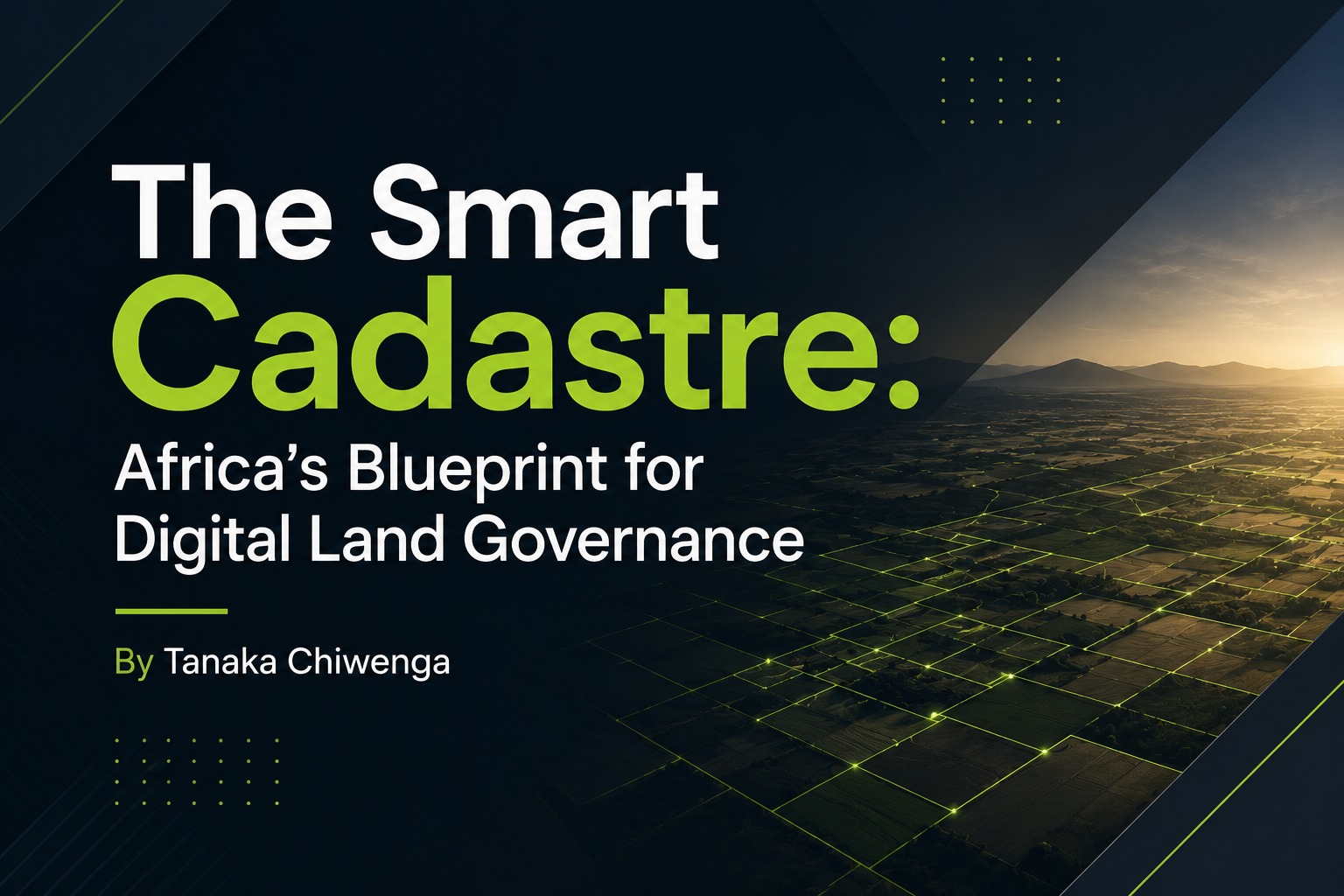
Artificial intelligence, blockchain and geospatial technologies are redefining land administration—offering African governments a chance to build more transparent, efficient and trusted systems.
By Tanaka Chiwenga
HARARE – ACROSS the world, governments have spent decades modernising the way they manage land. Paper maps have become digital maps. Manual records have been replaced by electronic databases. Land transactions that once took weeks can now be completed much faster through digital platforms.

Africa is part of this journey. Countries such as Rwanda, Kenya, Ghana, Zimbabwe, and Ethiopia have, by various accounts, made notable strides in digitising land administration. Their efforts have improved access to land records, strengthened public services, and increased confidence in property ownership.
The conversation today is no longer about whether land records should be digital. The real opportunity is to build the next generation of cadastral systems—systems that combine Artificial Intelligence (AI), Blockchain, Geographic Information Systems (GIS), satellite imagery, drones, and digital identity to create smarter, more secure, and more transparent land administration.
Understanding the Cadastre
A cadastre is a country’s official record of land parcels. It contains information about ownership, boundaries, location, size, and legal rights. It is one of the most important national information systems any government can maintain.
Every road that is built, every school that is planned, every housing project, every mining licence, every agricultural programme, and every property transaction depends on reliable land information. When land records are accurate and trusted, economies grow. When they are incomplete or unreliable, development slows.
Why This Matters for Africa
Land is Africa’s greatest natural asset. Yet many countries still face challenges such as overlapping land allocations, unresolved disputes, incomplete records, informal settlements, and lengthy registration processes. These challenges are not unique to Africa, but their impact is often greater because land plays such an important role in agriculture, housing, investment, and economic development.
Modern technology gives us the opportunity to improve these systems in ways that were impossible just a decade ago.
Artificial Intelligence Can Make Land Administration Smarter
Artificial Intelligence should not replace land professionals. It should empower them.
Imagine a registrar processing a new land application. Instead of manually searching through thousands of records, AI could automatically compare survey coordinates, historical maps, ownership records, and previous transactions to identify possible conflicts before approval. Surveyors could use AI to detect boundary inconsistencies from satellite imagery. Local authorities could identify illegal developments earlier. Governments could better understand urban growth, monitor environmental changes, and plan infrastructure using real-time land intelligence.
AI has the potential to transform the cadastre from a digital filing cabinet into a decision-support system.
Blockchain Can Strengthen Trust
Trust is one of the foundations of any land administration system. Blockchain, where implemented, offers a way to strengthen that trust.
Rather than replacing existing land registries, blockchain can provide an additional layer of security by creating an immutable record of transactions and ownership changes. Every approved transaction is securely recorded. Every change is traceable. Every authorised stakeholder works from the same trusted history. This increases transparency while reducing opportunities for unauthorised alterations or disputes.
Better Services for Citizens
A modern cadastre should not benefit only government. It should improve the lives of ordinary citizens.
A farmer applying for agricultural finance should be able to verify land ownership quickly. A family purchasing property should have confidence that ownership records are accurate. An investor should be able to complete due diligence without spending months searching for documents. Faster services reduce costs, increase confidence, and encourage investment.
Planning Better Cities
Africa is experiencing one of the fastest rates of urban growth in the world. Cities require accurate land information to plan roads, hospitals, schools, water networks, electricity infrastructure, and public transport. Without reliable cadastral information, planning becomes difficult. Modern cadastral systems provide planners with accurate, up-to-date information that supports better decision-making and more sustainable urban development.
Supporting Agriculture and Food Security
Agriculture remains the backbone of many African economies. Accurate land information helps governments understand land use, irrigation needs, crop distribution, and agricultural expansion. AI can analyse satellite imagery to monitor crop health, identify changes in land use, and support drought planning. Reliable land records also make it easier for farmers to access financing, insurance, and government support programmes.
Building African AI with African Data
One important lesson from Artificial Intelligence is that models perform best when they understand the environment they serve. African land systems are unique. They include customary land rights, communal land, traditional leadership structures, resettlement programmes, and legal frameworks that differ from those found elsewhere in the world.
There is a strong case for ensuring that these realities are reflected in the AI systems that support our governments. Instead of depending entirely on models trained using foreign datasets, African countries should invest in developing AI that understands African geography, African laws, African languages, and African land administration practices. Technology becomes more valuable when it understands the people it serves.
A Shared Opportunity for SADC
Countries across the Southern African Development Community (SADC) face many similar challenges in land administration. While each nation has its own legal framework, many share common objectives: improving service delivery, increasing transparency, reducing disputes, supporting investment, and strengthening public confidence.
This creates an opportunity for regional collaboration. Governments can share technical expertise, research, standards, and open technologies while adapting solutions to their own national requirements. Working together can reduce costs and accelerate innovation across the region.
The Next Step
The future of land administration is not about choosing between traditional cadastral systems and new technologies. It is about bringing them together.
Existing digital cadastral systems provide a strong foundation. Artificial Intelligence can make them more intelligent. Blockchain can make them more secure. GIS, drones, satellite imagery, and digital identity can make them more accurate, accessible, and efficient. Together, these technologies create a smarter public service that benefits governments, businesses, and citizens alike.
Africa has already begun its digital transformation in land administration. The next chapter is not simply digitisation—it is intelligence. It is building cadastral systems that do more than store records: systems that help governments make better decisions, systems that strengthen trust, systems that support agriculture, urban development, environmental protection, investment, and economic growth.
The technology already exists. The expertise exists. The need certainly exists. Now is the time to build upon the progress already made and create intelligent cadastral systems designed not only for today’s challenges but for Africa’s future.
As the saying goes, “A nation is built by its own people.” The same is true of the digital infrastructure that will shape the next generation. Africa’s future will be strongest when its technology is built with African knowledge, African priorities, and African ambition.
Tanaka Chiwenga is a Zimbabwean blockchain and AI innovator, community leader and Co-Founder of Crownbit Digital. He is passionate about leveraging emerging technologies to solve real-world challenges while bridging the gap between Web2 and Web3. Through his work, he advocates for African-led innovation, digital transformation and the responsible adoption of AI and blockchain to empower communities and strengthen the continent’s technological future. LinkedIn: https://www.linkedin.com/in/tanaka-chiwenga-09181a251?utm_source=share_via&utm_content=profile&utm_medium=member_ios
Discover more from Etimes
Subscribe to get the latest posts sent to your email.