


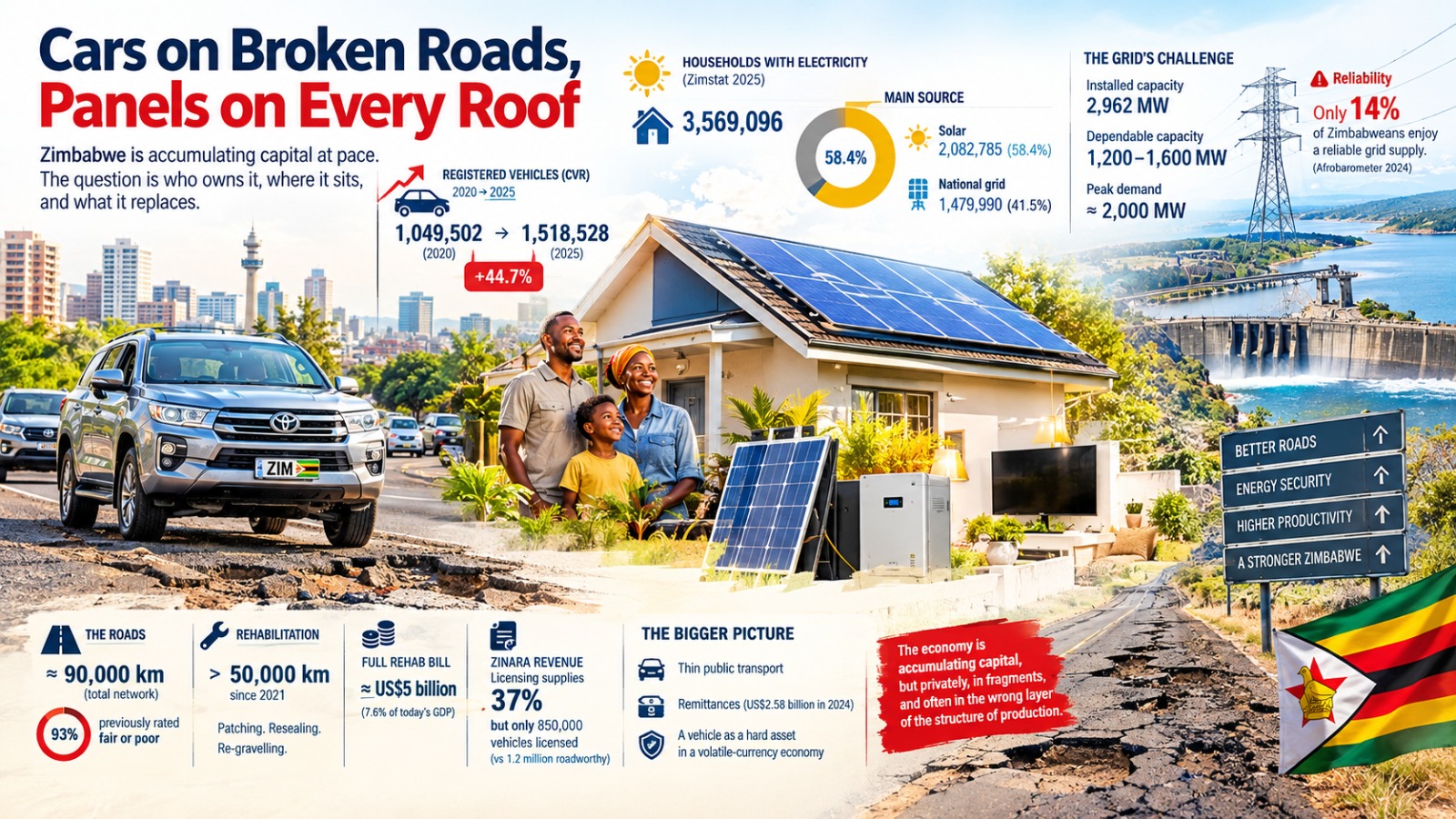
Zimbabwe is accumulating capital at pace. The question is who owns it, where it sits, and what it replaces.
By Jabulani Chibaya
Two charts crossed my timeline this week. They look unrelated. They are the same story.

The first shows the vehicle fleet climbing from 1,049,502 cars registered with the CVR in 2020 to 1,518,528 in 2025. The second, drawn from Zimstat’s 2025 ICT survey, shows that 58.4% of electrified households now run mainly on solar, against 41.5% on the national grid.

Read together, the charts say something blunt. When the public network fails, Zimbabweans do not wait. They buy their own. A private car replaces the bus. A private power station replaces the grid. The economy is accumulating capital, but privately, in fragments, and often in the wrong layer of the structure of production.
| Indicator | Figure |
| Registered vehicles (CVR), 2020 → 2025 | 1,049,502 → 1,518,528 (+44.7%) |
| Vehicles active on the road | About 1.2 million |
| Households with electricity (Zimstat 2025) | 3,569,096 |
| Main source: solar / national grid | 2,082,785 (58.4%) / 1,479,990 (41.5%) |
| Installed vs dependable generation | 2,962 MW vs 1,200–1,600 MW (peak demand ≈ 2,000 MW) |
| IMF 2026 GDP projection (Oct 2026 WEO) | US$65.92 billion |
Cars multiply. Roads do not.
Between 2020 and 2025 the registered fleet grew by 469,026 vehicles, about 7.7% a year. The IMF projects real GDP growth near 5% for 2026. The fleet is outrunning the economy that must pay for the road.
The road is not keeping pace. Authorities put the network at roughly 90,000 km, with about 93% previously rated fair or poor. The Emergency Road Rehabilitation Programme has attended to over 50,000 km since 2021, but its work is patching, resealing and re-gravelling. Nothing in the programme data suggests the network has grown anything like 45%. Earlier AfDB and World Bank-cited estimates put the full rehabilitation bill near US$5 billion, about 7.6% of today’s GDP.
The fiscal loop is perverse. Licensing supplies about 37% of ZINARA’s revenue, yet only about 850,000 vehicles were licensed in early 2025 against an estimated 1.2 million roadworthy ones. More cars should mean more road money. Non-compliance leaks the difference. Meanwhile every extra car adds axle loads to roads built for a smaller fleet, more congestion in the cities, and more demand for imported fuel.
The push factors are familiar: thin formal public transport, remittances (US$2.58 billion in 2024) that can fund private purchases, and a vehicle that doubles as a hard asset in a volatile-currency economy.

The sun overtakes the grid
Zimstat counts 3,569,096 households with electricity. Of these, 2,082,785 run mainly on solar, 1,479,990 on ZESA and 6,321 on generators. Solar leads by roughly 600,000 homes. In the 2020 survey, solar was the main source for about 46% of electrified households. In five years the sun has gained around twelve points, though “main source” is not “only source”, and many homes keep a grid connection as a backstop.
The grid’s own numbers explain the flight. Installed capacity is 2,962 MW, but dependable capacity runs at 1,200–1,600 MW against peak demand near 2,000 MW. Kariba, once about 45% of annual output, is held down by water rationing. Afrobarometer’s 2024 survey found that only 14% of Zimbabweans enjoyed a reliable grid supply.

Load-shedding has eased lately, with one parliamentary visit noting 188 consecutive days without nationwide cuts. Households that have paid for panels and batteries will not return. The capital is sunk, and the memory is long. Hayek would recognise the pattern: knowledge of local need is dispersed, and households acted on theirs faster than any central plan could. What dispersed action cannot do alone is coordinate the whole system.
The economics and what pushed us here
ZETDC’s tariff has sat near 16 US cents per kWh since December 2023. A household displacing 300 kWh a month avoids about US$48 monthly, roughly US$580 a year. On that arithmetic an illustrative US$3,000 system repays itself in about five years, before counting the value of light during an outage. Five years is a long bet in a country that remembers 2008 and 2019. In Böhm-Bawerk’s terms, households are lowering their time preference wherever they control the asset.
The push factors reinforce one another:
- Unreliable supply: a dependable-capacity gap of roughly 500 MW.
- Forex scarcity: electricity imports cost US$207.7 million in 2024 and US$117 million in 2025, and the first half of 2026 reached US$84 million.
- Currency risk: panels and batteries are portable, dollar-denominated assets.
- Remittances: hard currency arriving in households, ready to be converted into equipment.
- Cheaper kit and net metering: imported panels and lithium batteries are far cheaper than a decade ago, and net-metered capacity has reached about 94 MW.
For the utility the logic turns vicious. Each defecting customer leaves fixed costs spread across fewer kilowatt-hours. That pressures tariffs, which pushes more customers to defect.

What US$66 billion does and does not, tell us
The IMF’s October 2026 outlook puts 2026 GDP at US$65.92 billion, lifting Zimbabwe to Africa’s 14th-largest economy from 17th, with growth projected at 5%. Officials cite per-capita income near US$4,000.
Handle the number with care. Much of the jump is statistical catch-up. The 2025 rebasing, built on Zimstat’s economic census, lifted 2025 GDP to about US$52.4 billion and cut debt-to-GDP from roughly 60% to 45%. That is a change in the denominator, not the debt. Commentators have asked whether repeated revaluations are visible on the ground.
GDP is also agnostic about quality. Spending on a rooftop system counts as investment, and so would the same dollars spent on a reliable grid. A country that builds 3.5 million private power stations records activity, typically at a higher unit cost than utility-scale generation. And the rebasing was meant to capture the informal economy, yet the solar boom remains unmeasured. ZERA and Zimstat are only now preparing a survey to establish how much demand private solar meets.
Set the headline beside the bills. The US$9 billion energy compact and the roughly US$5 billion road estimate together come to about US$14 billion, around a fifth of GDP. A flattering debt ratio does not retire that bill. It only changes the arithmetic around it.
Capital accumulation and the energy matrix
Energy is the complement to nearly every other capital good. In the Austrian view, longer and more roundabout production processes need reliable inputs at every stage. Unreliable power shortens the structure of production. Firms retreat into short-cycle activity or duplicate capital as insurance. We are watching the second.
Households hold battery banks that sit idle for most of the day. More than half of the country’s 14 ferrochrome smelters are over 50% complete on their own power projects. This is defensive capital: it protects existing output rather than raising it. The accounting is uncomfortable too. Each household system is a small, indivisible lump of capital, sized for the worst night rather than the average day. Pooled, the same kilowatts would cost less.
The matrix is bifurcating. On the grid sit 1,680 MW of coal, 1,050 MW of large hydro and 232 MW of small hydro, bagasse and solar producers, with 1,365 MW of mostly coal capacity in the pipeline. Off the grid sits a fast-growing, unmeasured fleet of rooftop solar.
Then comes the paradox. Lithium products earned US$2.159 billion in January–September 2026, some 45.6% of mineral export sales. Zimbabwe ships the raw ingredient of the battery and imports the finished article.
The ripple through the indicators
Energy and transport costs sit inside every price, so the effects travel. Inflation: logistics and backup-power costs feed the cost base. External balance: electricity, fuel, vehicles, panels and batteries all draw foreign currency. Fiscal: ZINARA’s and ZETDC’s revenue bases leak. Productivity: backup capex diverts money from expansion. Growth: the 5% projection leans on agriculture and mining, both power- and logistics-intensive. Employment: installers, electricians and importers are a growing source of skilled work. Utilities: a shrinking base of paying grid customers raises the tariff needed to keep the system running, so tariff design and net-metering rules are now macroeconomic questions, not technical ones.
The opportunity inside the problem
Every failure in public capital is a market for private solutions, provided they connect to the system rather than merely substitute for it.
- Solar finance and service: pay-as-you-go plans, maintenance, battery recycling.
- Productive-use solar: irrigation, cold chains and milling, where reliability pays fastest.
- Local battery assembly from domestic lithium, ahead of the January 2027 concentrate export ban.
- Mobility services: formal bus operators, ride services and fleet telematics.
- Data: satellite imagery and AI to map rooftop solar and road condition.
Recommendations
For policymakers
- Make the grid a platform. Speed up net-metering approvals, enable wheeling and publish transparent buy-back rates. Keep tariffs cost-reflective, and resist cuts that lift demand before dependable capacity does.
- Measure what is being built. Publish the ZERA–Zimstat energy survey and reflect private capital formation in the national accounts.
- Put roads on a user-pays footing. Ring-fence ZINARA revenue, close the licensing gap digitally, and use toll concessions and warranty-backed maintenance contracts, since roads repaired under earlier phases have crumbled within two years.
- Open public transport to competition. ZINARA’s own CEO says it must expand. Licensed private operators can deliver that faster than a single state fleet.
- Sequence lithium policy. Align the 2027 ban with processing capacity, and avoid duties on batteries households need. An earlier duty regime meant to protect local battery makers never saw them reach scale.
- Mobilise domestic capital. Infrastructure bonds and pension funds can finance the grid and roads. ZB Financial Holdings has already raised over US$200 million for ZINARA.
For business
- Treat energy as a portfolio. Blend grid, solar and storage, and consider power-purchase or energy-as-a-service contracts rather than tying up working capital.
- Price the road into logistics. Use telematics, preventive maintenance and route planning to cut the hidden tax of poor roads.
- Cluster your demand. Industrial parks, farms and shopping centres can share mini-grids and storage, capturing economies of scale that single rooftops cannot.
- Finance with data. Banks and insurers that underwrite solar and fleets using usage data will win the next credit cycle.
- Build your own measurement. Track energy cost per unit of output. What you do not measure, you cannot protect.
The test ahead
A car on a broken road and a panel on a roof are both rational. Neither is a strategy. The test of the next five years is whether private capital forced to go it alone can be reconnected to public capital that can finally be trusted – HARARE

Sources
Vehicle fleet chart: newZWire, citing ZINARA. Household energy chart: Digital Democracy Initiative / @DailyViz263, citing Zimstat’s 2025 ICT Access by Households and Use by Individuals Survey. Illustrative payback figures are the author’s own arithmetic.
- Herald: Zim rises to Africa’s 14th largest economy
- Bulawayo24: Zimbabwe emerges as SADC’s second largest economy (rebasing)
- The Independent: Is Zim really a middle-income economy?
- AllAfrica: Zimbabwe’s growth and remittances
- The Independent: Zinara targets one million licensed vehicles
- Bulawayo24: ERRP2 and road network condition
- Business Times: ZB raises US$200m for road rehab
- The Standard: Govt turns to banks to fund roads rehab
- Energy News Network: Zimbabwe power generation set to add 1,365MW
- Equity Axis: Power import bill reaches US$84m in first half
- Bulawayo24: Electricity import bill 2021–2026
- Techzim: 2020 ICT survey, solar as main source
- Afrobarometer: Zimbabweans grow dissatisfied with electricity provision
- Herald: Zimbabwe clocks 120 days without load shedding (tariff)
- Bulawayo24: 115 days without load shedding (ferrochrome captive power)
- NewsDay: ZERA to survey private solar boom
- SMM: Zimbabwe lithium exports, first three quarters of 2026
- Gulf Times / Thomson Reuters: Zimbabwe removes barriers to solar
Discover more from Etimes
Subscribe to get the latest posts sent to your email.