


By Tonderai Godknows Mapfumo
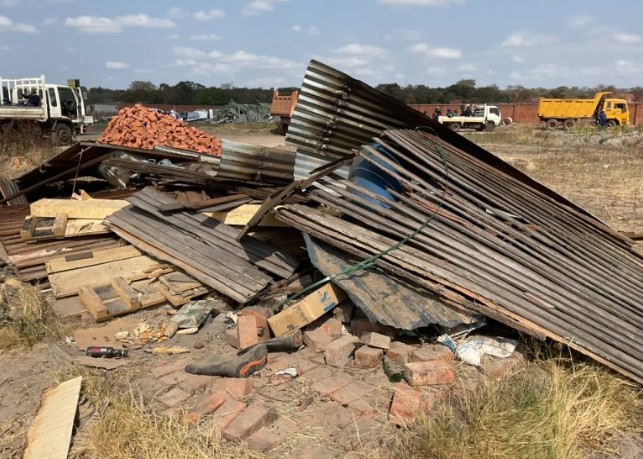
HARARE – ZIMBABWE’S cities are once again hearing the roar of bulldozers. From Harare South and Whitecliff to Stoneridge, Belvedere, and Budiriro, authorities are pressing ahead with a wave of demolitions framed as the enforcement of planning law, the protection of wetlands, and the reclaiming of land from “land barons”. On the surface, the case for clearance appears straightforward: illegal structures on reserved land must be removed, and a state that cannot enforce its own bylaws forfeits the credibility needed to attract investment and maintain urban order.
Yet a balanced accounting of Zimbabwe’s demolition experience tells a different story. The economic ledger of clearance—direct fiscal outlays, destroyed private capital, lost livelihoods, and macroeconomic shocks—is overwhelmingly negative. More importantly, a credible and demonstrably cheaper alternative already exists within Zimbabwe’s own policy framework: in-situ upgrading, regularization, and tenure formalization. The argument here is not that planning rules should be abandoned, but that the bulldozer is the most economically irrational instrument available for achieving them.

The Stated Case for Demolition: Order, Legality, and Land Recovery
Defenders of demolition point to real governance failures. Harare’s town clerk has reported that illegal settlements are linked to land barons, politically connected individuals, and organised groups occupying land reserved for schools, clinics, and environmental protection. The city has surveyed over 22,000 sites and warns that structures on prohibited land—wetlands, heritage sites, school sites—will not be spared. From this perspective, demolition is a necessary, if painful, corrective to a decade of permissive land allocation that allowed the “eviction economy” to flourish, in which land barons and corrupt officials profited while low-income families were left exposed.
There is also a fiscal argument, however weak in practice: the state cannot afford to service every illegally occupied stand, and allowing settlements to remain on hazardous or environmentally sensitive land creates future public liabilities. Bulawayo has ruled out regularizing the Ngozi Mine settlement near a landfill, describing it as temporary and unsustainable. In this framing, demolition is a “last resort” that protects the integrity of the city and future residents.
These are not trivial concerns. But they describe a governance problem that demolition does not solve—it simply redistributes its costs onto the poorest households and the wider economy.
The Direct Fiscal Costs: Compensation, Litigation, and “User Pays” Illusions
The first economic cost of demolition is the one authorities least like to discuss: the state and municipalities often end up paying for it, either through compensation or through litigation they lose.
The government’s own record shows that compensation is not a marginal expense. For the Mbudzi Interchange project in Harare, the state paid US$38 million to 51 property owners affected by the construction. For the Trabablas Interchange, US$26 million was allocated for relocation and compensation. These are cases of planned public infrastructure, where compensation is legally required and budgeted. But they establish the principle that demolishing property has a fiscal price.
When demolitions proceed without due process, the price shifts to the courts. In Mazowe, 22 villagers were awarded US$30,864 in damages after government-backed demolitions, with individual awards ranging from US$200 to US$2,000. In Harare, a kiosk owner claimed US$18,862 for the demolished structure, loss of business, and goodwill. Harare ratepayers have been warned they will bear the compensation cost for a wrongful building approval that led to a demolition order—a cost layered on top of a US$144 million Chinese loan for water and sewage reticulation.
Then there is the cost of the demolition operation itself. Harare’s council has made clear that owners who do not comply “will bear the full cost of demolition, rubble removal, site clearance and restoration”. In practice, poor households cannot pay these costs. The result is either unrecovered municipal expenditure or a second wave of displacement as families are pursued for debts they cannot meet.
The Destruction of Private Capital and Livelihoods
The deeper economic cost is not what the state spends, but what it destroys. A house in a high-density suburb is not merely a shelter; it is the household’s largest asset, often built incrementally over years through savings, remittances, and informal enterprise. When it is flattened, that capital is annihilated—it does not transfer to another productive use.
In Stoneridge, residents “invested their life savings, erected homes, established businesses and enrolled their children in schools built within the settlement”. The demolitions left them counting losses on investments made over years. In Harare’s latest blitz, businesses have lost goods “worth thousands of US dollars”. The council’s own framing acknowledges that tens of thousands of small and medium-sized businesses are at risk.
These are not isolated losses. Between May and July 2005, 700,000 people lost their homes, their livelihoods, or both under Operation Murambatsvina. Some 32,538 small, micro, and medium-sized enterprises were destroyed. A preliminary estimate put the losses at around US$700 million, equivalent to 15 to 20 per cent of GDP. The indirect effects—income shocks, homelessness, disrupted education and health, eroded social capital—are cumulative and slow, but they suppress productivity and tax revenue for years.
The informal sector is not a marginal add-on to Zimbabwe’s economy; it is the mainstay of urban survival. As formal employment has collapsed, vending and micro-enterprise have absorbed the displaced. Demolishing vending stalls and informal businesses is therefore not “cleaning up” the economy—it is destroying the only income stream available to a large share of the urban population, with immediate knock-on effects for food security, school fees, and health spending.
The Political Economy: Who Actually Profits from Demolition?
A balanced economic analysis must ask who captures the value from clearance. The evidence suggests that the principal beneficiaries are not the public, but a network of land barons, politically connected developers, and officials who operate in the space between permissive allocation and selective enforcement.
Investigations have exposed an “eviction economy” in which land barons sell unserviced or disputed stands to desperate home-seekers, often with the implicit or explicit tolerance of authorities, and then disappear when the bulldozers arrive. In one case, land barons pocketed approximately US$90,000 per month from container shops with no water, no toilet, and no lease agreement. In Hopley, a development company paid only US$12,000 toward land with an intrinsic value of US$300,000, while residents faced displacement.
The “user pays” principle, under which residents are required to pay the rightful owner for land and servicing costs, has been piloted at Whitecliff Farm. While this may offer a path to regularization for some, it also risks legitimizing the inflated prices extracted by intermediaries. The economic question is not whether land should be paid for, but whether the public purse and poor households should bear the cost of a governance failure that enriched a narrow elite.
The Economic Alternative: Upgrading Is Cheaper, Faster, and More Productive
The most powerful argument against demolition is comparative: Zimbabwe already has evidence that upgrading and regularization deliver better economic outcomes at a fraction of the cost.
The Dzivarasekwa Extension slum upgrading project, run by Dialogue on Shelter, the Zimbabwe Homeless People’s Federation, and the City of Harare, demonstrates that incorporating informal settlements into town plans is a “viable alternative to the state’s default demolition and resettlement policy”. The numbers are striking. Through the Harare Slum Upgrading Finance Facility and the Gungano Urban Poor Fund, the average unit cost for a basic 24-square-metre house was US$2,400, financed through community savings and small loans. By contrast, the World Bank has estimated that conventional site-and-service options can run from US$2,155 for a basic plot to US$5,180 for a standard unit—before accounting for the much higher costs of clearance, relocation, and the destruction of existing assets.
The comparative literature is even more direct: slum upgrading “can cost up to ten times less than clearance or relocation”. This is not a marginal efficiency gain; it is an order-of-magnitude difference. Clearance requires bulldozers, security, temporary accommodation, compensation, litigation, and the reconstruction of destroyed capital. Upgrading requires incremental servicing—water, sanitation, roads, drainage—and the legal recognition of existing occupancy. The former destroys value; the latter adds it.
Regularization also unlocks what economists call “dead capital.” The Presidential Title Deeds and Settlement Regularisation Programme, launched in Epworth in 2023, has already issued title deeds to families in Cowdray Park, Southlea Park, Epworth, and Mutare. The government’s own framing is explicitly economic: title deeds allow homeowners to “access finance, improve their properties, start businesses and contribute meaningfully to local economic development,” transforming untitled land into productive assets and enabling families to use property as collateral. This is the opposite of demolition: instead of destroying informal capital, it formalizes and leverages it.
Even the “reparative policy agenda” emerging from academic research points in the same direction: due-process guarantees, fit-for-purpose tenure instruments, city-wide multi-year in-situ upgrading, participatory planning, and livelihood-supportive market infrastructure. These are not utopian proposals; they are already being implemented in fragments across Zimbabwe. The economic case is for scaling them up, not for replacing them with bulldozers.
A Balanced Conclusion: Enforcement Without Destruction
The case for demolition rests on real problems: land barons, illegal occupation of wetlands and school sites, and a planning system that has been selectively enforced for decades. But the economic evidence shows that demolition is a response that magnifies the problem it claims to solve. It destroys private capital, eliminates livelihoods, generates compensation and litigation costs, and produces macroeconomic shocks whose effects persist long after the rubble is cleared.
A more economically rational approach would distinguish between illegality and disposability. Structures on genuinely hazardous land—wetlands, flood plains, active landfill buffers—may require relocation, but even then, the cost of compensation and resettlement must be compared with the cost of mitigation and servicing. For the vast majority of settlements, the evidence supports a different sequence: enumerate, regularize, service, and integrate. This is not a concession to lawlessness; it is a strategy for building a tax base, a property market, and a productive urban citizenry.
Zimbabwe’s fiscal space is severely constrained. Every dollar spent on bulldozers, security, and compensation is a dollar not spent on water, sanitation, and title deeds. The economic choice is not between “order” and “chaos,” but between two forms of order: one that destroys capital and calls it enforcement, and one that creates capital and calls it development. On the evidence available, the second is both cheaper and more just.
Discover more from Etimes
Subscribe to get the latest posts sent to your email.