


An Austrain Reading of Zimbabwe’s 2026 Monetary Shift
By Jabulani Simplisio Chibaya
HARARE – ZIMBABWE’S latest monetary snapshot for Q1 2026 presents what, on the surface, appears to be a remarkable turnaround: single-digit inflation, exchange rate stability, rising foreign reserves, and a current account surplus. For a country with a long history of monetary instability, this is no small feat.

But beneath the headline numbers lies a deeper economic question: Is this stability organic and sustainable, or is it managed and therefore fragile? Through the lens of Austrian Economics—where emphasis is placed on sound money, market-driven price discovery, and minimal intervention—the answer becomes more nuanced.
The Success Story: Discipline Returns—At Least on Paper
There is no denying the progress.
Inflation, long Zimbabwe’s Achilles heel, has been tamed to 4.1% in January and around 4.4% by March 2026, with month-on-month inflation averaging just 0.2%. This signals a dramatic slowdown in price increases—something unseen in over three decades.
At the same time, the exchange rate has stabilized around ZiG25/USD, with the parallel market premium contained below 20%. In Zimbabwean terms, that is a form of convergence—an important psychological anchor.
Money supply growth has also been restrained:
Reserve money rose modestly from ZiG5.3 billion to ZiG5.8 billion
Broad money growth averaged 2.3%
From an Austrian perspective, this is critical. Inflation is ultimately a monetary phenomenon, and controlling the growth of money supply is the first step toward restoring credibility.
Even more significant is the build-up of foreign reserves to US$1.4 billion, covering:
6x reserve money
Nearly 2x ZiG deposits
This is perhaps the strongest pillar of the current framework. A currency backed by tangible reserves—especially in a dollarized economy—is far more credible than one built purely on policy promises.
The External Anchor: A Stability Borrowed from Commodities
However, the source of this stability matters.
Foreign currency inflows surged 54% year-on-year to US$4.97 billion, driven largely by:
Gold and PGM exports
Tobacco earnings
Lithium demand
Diaspora remittances
This has produced:
Trade surpluses
A projected current account surplus of US$590 million
From an Austrian lens, this raises a red flag: Zimbabwe’s monetary stability is not purely endogenous—it is heavily dependent on external commodity cycles.
This means:
Stability is imported, not internally generated
It is vulnerable to commodity price shocks
It is tied to global liquidity conditions, not domestic productivity
In Austrian terms, this is not yet a “sound money equilibrium”—it is a conditional equilibrium.
Where Policy Aligns with Austrian Thinking
There are clear areas where policy is moving in the right direction:
- Controlled Money Supply
Limiting reserve money growth aligns directly with Austrian prescriptions against inflationary expansion.
- Reduced Central Bank Financing of Government
The shift toward non-central bank financing of fiscal deficits is critical. Historically, monetized deficits were the root of Zimbabwe’s hyperinflation cycles.
- Reserve Accumulation
Backing the currency with reserves introduces an element of discipline—closer to a commodity-backed system than fiat excess.
Where It Breaks from Austrian Principles
Despite the progress, several structural contradictions remain:
- Exchange Rate is Not Fully Market-Determined
The Willing-Buyer Willing-Seller system is still supported by US$1.6 billion in central bank interventions since 2024.
Austrians would argue:
True price discovery is being distorted
The exchange rate may be artificially anchored
- Interest Rates Remain Distortionary
The policy rate at 35% reflects tight monetary conditions—but also signals:
High cost of capital
Suppressed private sector credit formation
This leads to malinvestment avoidance, but also growth suppression—a delicate balance.
- Low Confidence in Local Currency Usage
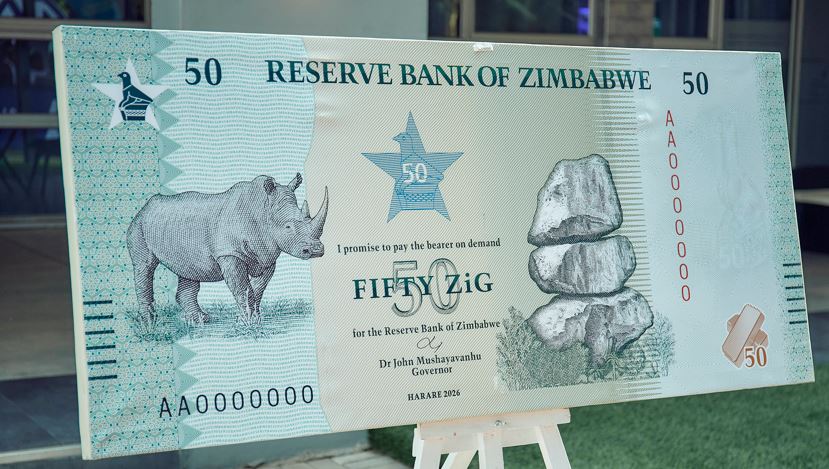
Despite the rollout of new banknotes, ZiG loans account for only 16.5% of total loans.
This reveals the real truth:
The economy is still structurally dollarized
Trust in local currency remains shallow
In Austrian thought, money emerges from trust and voluntary adoption, not policy campaigns.
The Underlying Structural Issues
The current stability masks deeper economic fundamentals:
- Production vs Liquidity Gap
Liquidity is improving, but domestic production capacity remains weak. Growth is projected at 5%, but agriculture has already faced a dry spell—highlighting vulnerability.
- Dual Currency Reality
Zimbabwe still operates in a de facto dual monetary system, where:
USD is the store of value
ZiG is a transactional currency
This creates persistent currency substitution risk.
- Import Cover Still Low
At 1.5 months, reserves are improving—but still below the 3–6 month threshold required for true currency confidence.
Stability Outlook: Fragile but Improving
The central bank projects continued stability:
Inflation expected to remain in single digits
Exchange rate premium to stay below 20%
Reserves to keep rising
But from a deeper analytical standpoint:
Short-term (6–12 months):
Stability likely to hold, supported by strong exports and tight liquidity
Medium-term (1–3 years):
Risks emerge if:
Commodity prices weaken
Fiscal discipline slips
Money supply expands beyond productivity
Long-term:
True stability will only come when:
The currency is trusted without coercion
Growth is production-driven, not export-cycle-driven
The monetary system is fully market-based
What the Common Man Should Understand
Strip away the jargon, and a few practical truths emerge:
- Prices are stable—for now
This is good, but it depends on discipline continuing. - The currency is stronger—but not fully trusted
Keep a diversified approach to savings. - Economic stability is tied to exports
If gold, tobacco, or remittances fall, the system comes under pressure. - Policy discipline is the real anchor
If government and central bank stay disciplined, stability holds. If not, history can repeat.
Final Word
Zimbabwe is not yet at monetary normalcy—but it is no longer in monetary chaos.
What we are witnessing is a managed stabilization phase, not a fully organic one. The Austrian critique would frame it this way:
Stability built on discipline and reserves is promising.
Stability sustained by intervention and external flows is vulnerable.
The path forward is clear but difficult:
less control, more market; less intervention, more trust; less liquidity engineering, more real economic production.
Only then does stability become permanent—not policy-driven, but system-driven.
Jabulani Simplisio Chibaya is a Data and AI Consultant specializing in data science, artificial intelligence, blockchain, and cryptocurrency innovation. A seasoned conference speaker, he also writes on the intersection of technology, regulation, and economic development. Contact: Cell: +263 778 921 881, Email: simplisiochibaya22@gmail.com, LinkedIn: https://www.linkedin.com/in/jabulani-simplisio-chibaya
Discover more from Etimes
Subscribe to get the latest posts sent to your email.