


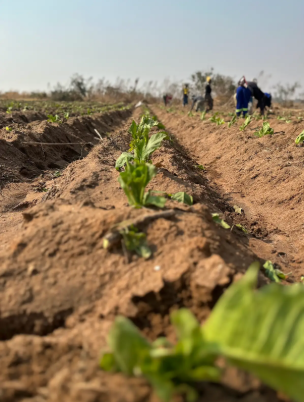
Zimbabwe has just been given a painful reminder of why farming can no longer be left to chance.
By Newton M. Mambande
HARARE – ON THE evening of Monday, 5 October 2026, a catastrophic hailstorm tore through Masvingo. According to preliminary assessments cited by the Department of Civil Protection, President Mnangagwa has declared a State of Disaster under Section 27(1) of the Civil Protection Act. The figures are sobering: approximately 8,500 households had roofs completely blown off, while 17,000 households were assessed, with about 90% sustaining shattered windows. ZESA lines were brought down, water and sewer systems were crippled, and key institutions — including Great Zimbabwe University’s Mucheke Campus, Masvingo Polytechnic, Masvingo Teachers’ College, the GMB depot, Masvingo Airport and the Runyararo Clinic Maternity Ward — were severely damaged.

If brick, mortar and steel could not survive, what of our unprotected crops in the field? A farmer in Mwenezi reportedly lost his two-hectare maize field and roundnuts in minutes. That is the face of climate risk in 2026.
It is against this background that I want to applaud a progressive move by the Tobacco Industry and Marketing Board (TIMB). TIMB has publicly urged its constituency of over 135,000 tobacco households to insure their crop as weather-related threats increase. This is leadership.
In the 2025/26 season, TIMB reported that on 28 November alone, 130 hectares of tobacco were destroyed by hail at Wilmont, Chidziva and Dahwe Farms in Mashonaland Central. A good-looking crop in Manicaland was also wiped out on 2 December. The difference? The Manicaland grower who had insured his crop is already receiving his payout, while the uninsured are counting losses. As ZNFU President Monica Chinamasa, who lost 40 hectares of irrigated tobacco to hail, rightly said: “We advise all farmers to insure their tobacco against natural hazards, if they take farming as a serious business.”
If tobacco — our golden leaf, which earned US$882.5 million from 353.8 million kg last season — needs insurance, how much more our maize, sorghum and horticulture that feed the nation?
As we prepare for the 2026/27 summer cropping season, which forecasters warn will bring below-normal rainfall due to El Niño effects, every farmer — from communal to A2 — must treat crop insurance as an input, just like seed and fertiliser.
WHAT is crop insurance?
Many farmers think insurance is only for cars. Crop insurance is simple: you pay a small premium (usually 4% to 8% of your expected crop value) to a registered insurer, and if your crop is destroyed by hail, windstorm, flood, drought, frost or fire, the insurer compensates you for input costs or lost income.
In Zimbabwe we have two main products:
1. Single-peril cover: Covers hail and windstorm — ideal for tobacco, tomatoes and berries.
2. Multi-peril and Weather-Index cover: Covers drought, excess rainfall and yield shortfall — critical for maize and small grains under Pfumvudza.
Insurers such as Zimnat, AIC Insurance, Old Mutual, Econet Moovah and Cell Insurance offer these through TIMB, AFC and Cottco contracts.
WHY must every farmer insure in 2026/27?
1. Climate is no longer predictable. The Masvingo disaster is not isolated. We have seen hail in November in Mashonaland Central, floods in Muzarabani, and dry spells in Matabeleland in the same season.
2. Food security is national security. When one farmer loses two hectares, his family goes hungry. When 10,000 farmers lose two hectares each, the nation imports grain. Insurance keeps farmers in business the next season.
3. Farming is now a business with loans. Most farmers are on contract or AFC loans of about US$1,000 per hectare. If hail destroys the crop, the debt remains. Insurance pays the loan and protects your credit record.
HOW does a farmer take crop insurance?
It is easier than many think. Do not wait for disaster.
Step 1: At planting registration, ask your contractor, TIMB officer or AFC loan officer to include insurance. For tobacco, TIMB now requires proof of insurance for contracted growers.
Step 2: Get a field assessment. The insurer will capture your hectarage, GPS coordinates and expected yield. For index insurance, your ward’s rainfall station data is enough.
Step 3: Pay the premium. It can be deducted as a stop-order from your sales, just like inputs. For illustration, a US$5,000/ha tobacco crop costs roughly US$200–US$300 to insure.
Step 4: When disaster strikes, report within 72 hours. Take photos and call your insurer and Agritex officer. Do not reap or disc the damaged field until assessment is done.
Step 5: Get compensated and replant. TIMB has shown that insured farmers get paid within weeks.
My call to Government, TIMB, GMB and the private sector is this: let us make crop insurance mandatory for all contracted crops and for all beneficiaries of Presidential Inputs in 2026/27. Let us subsidise premiums for smallholders as we do for fertiliser. The cost of a premium is nothing compared to the cost of rebuilding Masvingo — 8,500 roofs, 17,000 windows, a university, an airport and clinics.
Food security does not come from good rains alone. It comes from good risk management.
Newton M. Mambande is an entrepreneur, farmer and author. He writes on agribusiness strategy, food security and rural development, economics, and the economic history of finance and business. He is reachable at newtonmunod@gmail.com or +263773411103.
Discover more from Etimes
Subscribe to get the latest posts sent to your email.