


By Jabulani Chibaya
HARARE – ON Wednesday, Wall Street celebrated. On Thursday, it flinched. In between, the Dow posted its best post-midterm day in 44 years, then surrendered it, and roughly US$3 trillion of market value went with it.
Meanwhile, in France, a supermarket freezer aisle had quietly become a front line. And in Harare, a finance minister had trimmed next year’s growth forecast because of rain that has not yet fallen.

Three stories. One plot.
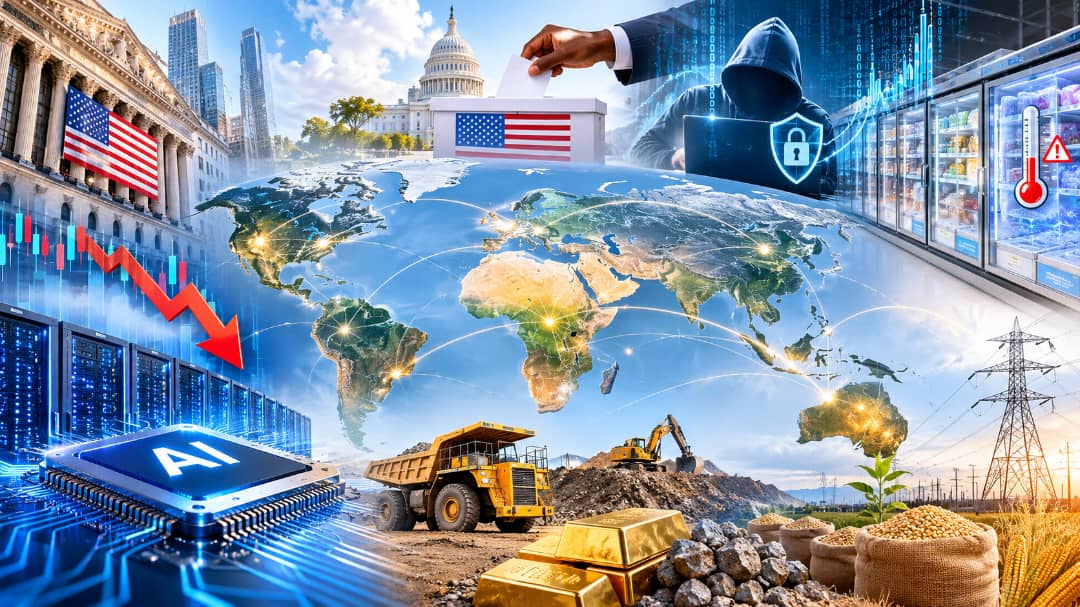
The plot is this: the world spent a decade building things faster than it could power, protect or pay for them. The AI boom ran on cheap capital and political goodwill. Both just expired. This is not a crash story. It is a repricing story: of electricity, of security, of commodities, and of time itself.
Kierkegaard said life is understood backwards but lived forwards. So let us read the week backwards, then live toward 2027.
The Day the AI Bet Met the Ballot Box
The crash was not about earnings. It was about permission.
For two years, the AI trade rested on one assumption: that the data-centre buildout would accelerate without friction. On Thursday the market asked a harder question. Who gets to say no?
The ballot box answered. Fortune reports that 41 measures aimed at slowing data-centre construction were on Tuesday’s ballots, and most passed, especially in Ohio. Euronews reports that Democrats won both chambers of Congress. In Texas, which Wells Fargo estimates holds 27% of planned data-centre capacity, a challenger promising an immediate moratorium reportedly beat the governor. Add expensive borrowing, and the buildout’s arithmetic suddenly looked fragile.
The damage was concentrated. The Philadelphia Semiconductor Index fell almost 10%, its worst day since March 2020. Nvidia lost 8 to 9%, AMD and Micron about 15% each. AP’s report tied it to fears of slower data-centre construction and costly debt. Bloomberg calculated that Jensen Huang’s net worth fell US$15.1 billion, dropping him from ninth to 13th on its billionaires index.
Now, the noise. Social media shouted “largest wipeout in history” because US$2.8 trillion beats the US$2.69 trillion lost in the COVID crash. One sharp reply on LinkedIn, from George Aliferis, noted that the US market is now more than twice its 2020 size. The S&P 500 fell about 4%. In March 2020 it fell more than 10% in a single session. A record in dollars is arithmetic, not panic.
The signal is subtler. Elections rarely move trillions. This one did because it touched the one thing the AI thesis could not model: time. Böhm-Bawerk would nod. You can build a better model in weeks. A power plant, a transmission line and a permit take years. The market had priced software speed onto physical timelines.
Notice what rose: consumer staples, and Berkshire Hathaway to an all-time high. Capital did not flee. It rotated toward the boring.
The Fridge Is the Canary
On the night of 11 October, somebody reached into France’s cold chain and turned the heat on.
According to Wikipedia’s account of the incident, attackers accessed refrigeration controllers in hundreds of Intermarché, Netto, Carrefour and other stores, and set them to defrost with food still inside. No alarms sounded. Few staff were on site. By morning, many units had reached about 50°C, and one Normandy store hit 80°C. Losses were put in the tens of millions of euros. The weak point was refrigeration controllers reachable from the internet, some of them models that reached end-of-life in 2016 and 2021 and never received updates. The flaws had been disclosed in 2025, and a patch existed for one series. Many units were never updated. CNBC and NBC News have since reported further fridge attacks across European supermarkets.
Notice what was not hacked: no bank, no database, no AI model. A thermostat.
That is the lesson. Cyber risk has migrated from information to atoms. The attack surface is now the physical economy: cold chains, pumps, grids, clinics, mines. Nobody has publicly shown who did it. Analysts say amateurs could manage it, and states certainly could. Cheap sabotage, expensive defence.
Why does a fridge belong in an essay on markets? Because the same fragility sits under the AI buildout. Every new data centre, substation and cold room is another networked asset, bought at speed and secured as an afterthought. Resilience is the cost the boom never priced. 2027 will start pricing it.
Zimbabwe: Rich in Rock, Poor in Rain
A commodity exporter is a price taker. Zimbabwe’s fortunes are written in London, Shanghai and Chicago before they are read in Harare.
2026 has been kind. Government expects mineral export receipts of US$6.5 to 7 billion this year, The Anchor reports. The Minerals Marketing Corporation says first-quarter mineral exports rose 84% to US$2.532 billion, and lithium alone earned US$746 million in the first half, almost all of it spodumene concentrate. Gold briefly topped US$5,500 an ounce and has since eased towards US$4,500. Lithium recovered above US$16,000 a tonne early in the year.
Now the risks. There are three, and they compound.
Weather. Finance Minister Mthuli Ncube cut the 2027 growth forecast to 3.5% from 5%, citing an El Niño drought. Growth was 8.3% in 2025. Drought hits crops, food import bills and power supply, and mines run on power.
The price cycle. Part of gold’s rally is a fear trade tied to the Iran war and the Hormuz disruption. Peace is good for the world and bad for gold. A budget built on peak prices is a budget built on someone else’s anxiety.
The AI shock. Lithium and copper demand lean on electrification and data-centre power. If the buildout slows by a year, lithium’s fragile recovery wobbles first.
Now the opportunity: climb the value chain. Spodumene brought in over nine times the revenue of lithium sulphate, mainly on volume, not value per tonne. The margin sits in processing, and Arcadia and Bikita are moving that way. Each step up turns a price taker into a price shaper. A country that also finances that climb through its own capital markets, not only through foreign offtakers, keeps more of the upside at home.
What Will Define Exports and Growth in 2027
Five forces will decide who earns and who stalls.
- Power. Exporters who can guarantee reliable, affordable electricity will win processing, mining and data work. Everyone else ships raw material and watches others capture the margin.
- Value-add. Beneficiation is policy in Zimbabwe and a trend everywhere. Concentrate earns volume; sulphate, carbonate and refined metal earn margin.
- Security. War risk in shipping lanes, insurance costs and cyber-resilience now sit inside the price of every container. Brent at about US$97 after a near-9% one-day fall shows how jumpy that is.
- Weather. El Niño drought will raise food import bills across southern Africa and test power supply and crop exports.
- Cost of capital. The US 10-year yield fell to 4.84% from above 5.3% last month. Better, but still expensive. Mines, plants and grids are financed by patient money, and patient money is rationed.
The pattern: 2027 rewards exporters who sell proof (certified, traceable, processed, reliably delivered) rather than promise.
Signal, Noise and the Hidden Chain
Noise is anything that fades by Monday: dollar records, billionaire rankings, a single day’s percentage. Signal is anything that changes how capital gets built.
Follow the hidden chain, link by link.
- War in the Gulf and a disrupted Strait of Hormuz lift oil and shipping costs.
- Dearer fuel and freight keep inflation sticky. Writing for the Mises Institute, Ron Paul cites US consumer prices up 3.7% and real private-sector wages down 0.6% over a year. He also notes the Iran war’s bill is disputed (US$47 billion officially, US$103 billion on one independent estimate) and sits on US$38.5 trillion of federal debt.
- Sticky inflation keeps rates high, and high rates make debt-funded buildouts expensive.
- Expensive buildouts need cheap, fast power. Communities that carry the grid strain and the bills vote no.
- Votes become moratoria. Moratoria become fewer chip orders. Chip stocks reprice.
- Weaker expected power demand softens the outlook for copper and lithium, and eventually Harare’s budget.
Nobody planned that chain. Nobody could have. That is Hayek’s point about the pretence of knowledge: the economy is too interconnected for any forecaster, or any central bank, to model. The Austrian would add that war is paid for twice, once in taxes and again through the inflation tax.
So what does it say about 2027?
- The global economy: slower, more fragmented, costlier. Zimbabwe’s own forecast cut, from 5% to 3.5%, is a local version of a global mood.
- Markets: dispersion, not collapse. A 3% rally and a 4% drop inside 48 hours is what a change in beliefs looks like. Leadership narrows to the scarce and the cash-generating.
- Capital: a move from promise to proof. Permitted power, secured systems, processed minerals.
- Peace and stability: the master variable. A durable Gulf settlement would lower oil, ease inflation and rates, and revive the buildout, while hurting gold. Escalation does the reverse. Divided government in Washington narrows room for fiscal and trade surprises, but it does not end geopolitical ones.
These are scenarios, not forecasts. The discipline is to hold them loosely.
Ten Opportunities for 2027
None of these is a prediction. Each is a position on the repricing above. Study them, size them small and stage your entries.
| # | Opportunity | The 2027 logic | Names and markets to study |
| 1 | Power and grid equipment | Electricity, not chips, is the bottleneck, and permitted capacity is scarce. Expect volatility on every moratorium headline. | GE Vernova, Vertiv, Eaton, Siemens Energy |
| 2 | Gold and gold miners | Insurance against war, debt and policy error, with operating leverage in miners. Peace is the risk. | Newmont, Barrick, Agnico Eagle; GDX |
| 3 | Copper | Grids, data centres and electrification all need it, and new supply is slow to build. | Freeport-McMoRan, Southern Copper, Glencore |
| 4 | Lithium and battery materials | Prices have recovered from the 2024-25 slump, and processing captures the value. | Albemarle, SQM, Pilbara Minerals |
| 5 | Cybersecurity, including operational technology | The fridge hack shows physical systems are now targets, and budgets follow incidents. | CrowdStrike, Palo Alto Networks, Fortinet |
| 6 | European defence | Rearmament is a multi-year budget line that does not hinge on one election. | Rheinmetall, Saab, BAE Systems |
| 7 | Food, water and drought resilience | El Niño and cold-chain failures lift demand for inputs, irrigation and efficiency. | Deere, Nutrien, Xylem |
| 8 | Short-duration Treasuries and TIPS | With the 10-year near 4.84% and US inflation near 3.7%, cash-like yield pays you to wait. | T-bills, TIPS funds |
| 9 | Post-rout AI leaders, bought in stages | A delayed thesis is not a dead one, and chipmakers sold off hardest. Scale in; do not chase. | TSMC, SK Hynix, Nvidia; Taiwan and Kospi |
| 10 | Frontier commodity exporters | Mineral-rich markets with reform momentum gain if prices hold; currency and drought risk are high. | VFEX and ZSE miners, JSE miners |
This is analysis, not personal financial advice. I am not a licensed advisor, so test every idea against your own risk, horizon and currency.
A Note to the Entrepreneur
Your edge is not forecasting. It is optionality.
Do not build your business on the assumption that the AI boom continues, or that it ends. Build it to survive either. Five habits help.
- Sell resilience. Every cold room, mine, clinic and bank now needs monitoring, backup power and security. That is a market, not a cost centre.
- Own the step up. If you sell raw, pilot processing. If you sell processing, pilot branding and traceability.
- Keep debt short and cash visible. A 4.84% US 10-year says money is still dear.
- Use AI as a tool, not a story. Use it to cut cost and cycle time. Be wary of raising money on adjectives.
- Watch permits, not press releases. Where power, water and community consent are scarce, they are your real constraints.
The week taught one old lesson: the physical world still has the last word. Software moves in weeks. Trust, power and rain take years. Plan for both clocks.
Sources
- Wall Street’s best post-midterm rally in 44 years lasted one day (Fortune)
- A brutal sell-off for AI stocks sends Wall Street reeling (AP via NBC Bay Area)
- US midterm elections results 2026 (Euronews)
- 2026 French supermarket refrigerator hack (Wikipedia)
- Supermarket fridges hit with cyberattacks across Europe (CNBC), headline only
- Supermarkets across Europe hit by new fridge cyberattacks (NBC News), headline only
- Govt projects US$7bn mineral earnings for 2026 (The Anchor)
- Zimbabwe’s lithium exports hit US$746 million in first half of 2026 (allAfrica)
- Zimbabwe lowers growth forecast to 3.5 pct in 2027 amid drought fears (The Star)
- Ron Paul, “Republicans Deserve to Lose, but Democrats Do Not Deserve to Win” (Mises Institute, 3 Nov 2026); Linas Beliūnas and George Aliferis LinkedIn posts; Bloomberg’s Jensen Huang net-worth post.
Jabulani Simplisio Chibaya is a Data and AI Consultant specializing in data science, artificial intelligence, blockchain, and cryptocurrency innovation. A seasoned conference speaker, he also writes on the intersection of technology, regulation, and economic development. Contact: Cell: +263 778 921 881 | Email: simplisiochibaya22@gmail.com | LinkedIn: https://www.linkedin.com/in/jabulani-simplisio-chibaya
Discover more from Etimes
Subscribe to get the latest posts sent to your email.