


A Financial and Political Economy Analysis
By Newton M. Mambande
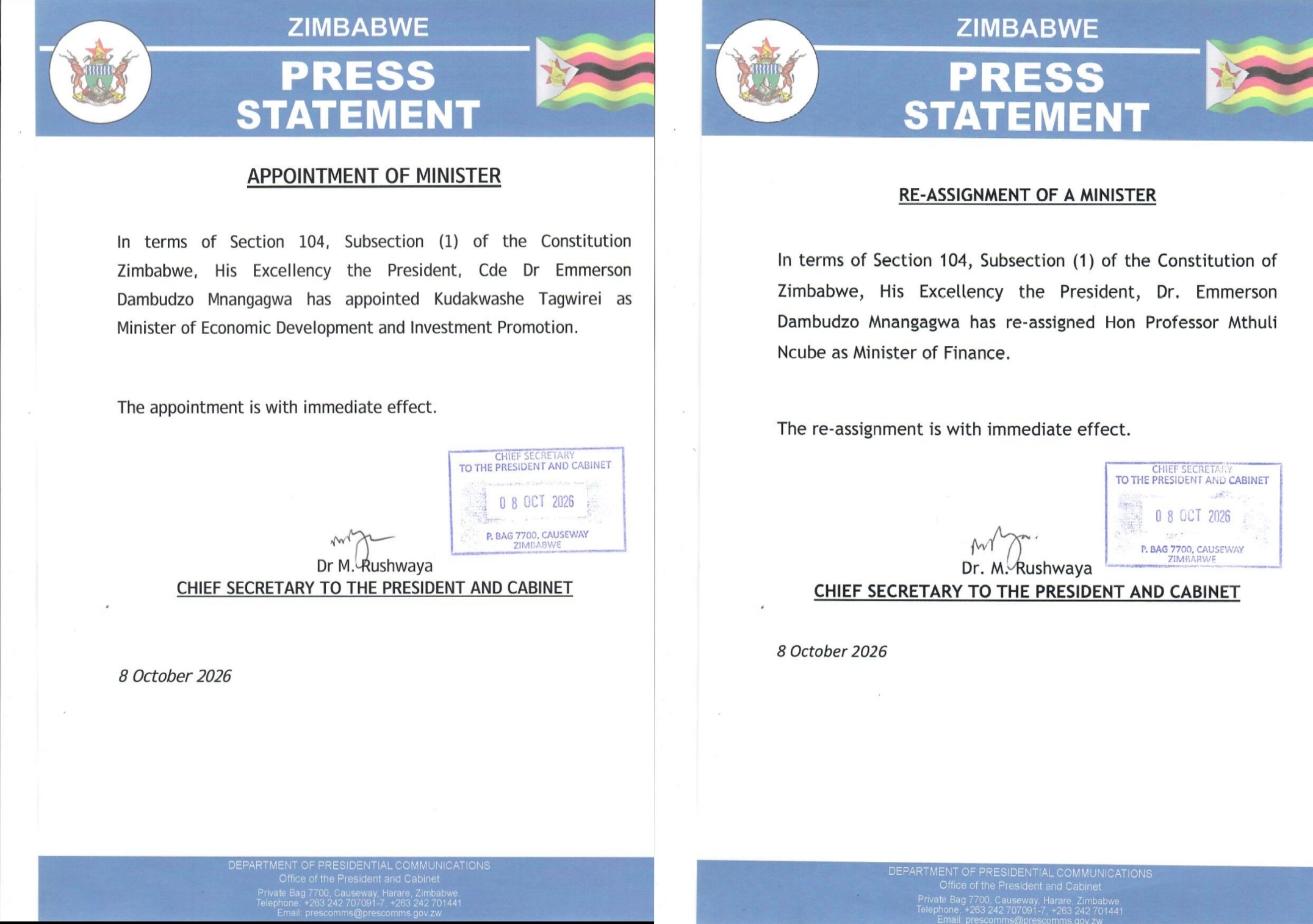
HARARE – PRESIDENT Emmerson Mnangagwa’s decision on 8 October 2026 to split the Ministry of Finance, Economic Development and Investment Promotion into two—reassigning Professor Mthuli Ncube as Minister of Finance and appointing Senator Kudakwashe Tagwirei as Minister of Economic Development and Investment Promotion—is the most consequential economic reconfiguration since 2018.

Under Section 104(1) of the Constitution, Tagwirei was sworn in as Senator in August 2026 and now moves into Cabinet. Ncube, who has held the combined portfolio since September 2018, now has a narrowed, but deeper fiscal mandate.
Biographies: Two Different Capitals
Professor Mthuli Ncube (born 1964) represents academic and technocratic capital. He holds a PhD in Mathematical Finance from Cambridge University and was the first African to earn an Economics PhD from Cambridge. He was a Lecturer in Finance at the London School of Economics at 28, Dean at Wits Business School (FT Rank 45 globally 2007) and the Faculty of Commerce, Law and Management at Wits, and a Visiting Professor at the Blavatnik School of Government and Said Business School, University of Oxford.
Professionally, he served as Chief Economist and Vice President at the African Development Bank (2010-2015), Portfolio Manager and Head of Asset Allocation Strategy at Investec Asset Management, founding Chairman of Barbican Bank and Selwyn Capital, Board Member of the South African Financial Services Board, Chairman of the African Economic Research Consortium, and served on the Global Agenda Council on Poverty at the World Economic Forum.
Kudakwashe Regimond Tagwirei (born 12 Feb 1969, Shurugwi) represents entrepreneurial and deal-making capital. Educated at Solusi University, he is the founder and former CEO of Sakunda Holdings, with interests in energy, mining, agriculture, infrastructure, and logistics. In 2013, Sakunda formed a 51/49 JV with Trafigura. He drove Command Agriculture financing and the Presidential Inputs Programme.
Updated Investment Portfolio: Tagwirei is a shareholder through associated vehicles in:
- CBZ Holdings Limited – Zimbabwe’s largest bank by assets. Reports dating to 2019 indicated he acquired about a 30% stake through Akribos Wealth Managers / Akribos Capital via nominee structures, held through Datvest Nominees. As of early 2025, Akribos was reported as the second largest shareholder with ∼23.10%, with NSSA largest at ∼24.91%. On 15 August 2026, the ZSE recorded a negotiated transaction of 62.28m shares (11.91% of CBZ) at ZiG39.99 via Akribos Nominees to the Public Service Pension Fund (PSPF), raising PSPF to 21.67%. Tagwirei denied selling, stating: “I have not sold anything. It’s not true.” Market speculation has linked Akribos to him, though beneficial ownership remains via nominees.
- ZB Financial Holdings Limited – NSSA disposed of its 37.79% stake in ZB to Tagwirei in 2020 via a share swap for CBZ shares worth ZW$640m.
- First Mutual Holdings Limited & First Mutual Properties – via CBZ Holdings, which acquired 31.22% from NSSA in 2023, creating a US$2.5bn financial behemoth.
- Masimba Holdings Limited, Bindura Nickel Corporation (BNC), Great Dyke Investments (50% via Landela Mining Venture), Kuvimba Mining House (reported ∼35%), Sotic International, Fossil Contracting, and Landela.
He chairs the Land Tenure Implementation Committee. Politically, he was co-opted into the ZANU-PF Central Committee in October 2025.
Comparative Analysis: What, How, and Why They Can Turnaround the Economy
Mthuli Ncube:
· What: Fiscal consolidation (2019 surplus), ZIDA Act 2019, Mutapa Investment Fund, and reducing inflation from 837% to single digits.
· How: Textbook austerity, tight monetary policy, value-for-money audits, and an IMF Staff Monitored Programme.
· Why It Failed: Academic models clashed with quasi-fiscal RBZ operations, a currency credibility deficit, and the over-taxation of a struggling population.
· Next 3 Years: As pure Finance Minister, his focus will be on budget balance, US$12.7bn arrears clearance, making ZiG the sole currency by 2030, and supervising Mutapa with prudence.
Tagwirei:
· What: Built the only indigenous company able to finance US$3bn in agricultural inputs and fuel for a landlocked economy under sanctions.
· How: Vertically integrated supply chain, Trafigura US$1bn lines, and alignment with State procurement.
· Why Risk: The US Treasury’s OFAC sanctioned him and Sakunda on 5 August 2020 under E.O. 13469 for “opaque business dealings” and allegations of US$3bn in unaccounted funds under Command Agriculture. The UK followed. This creates a perceived risk of tenderpreneurship, potentially crowding out SMEs.
· Next 3 Years: If he translates deal-making into project closure, bankable land tenure deeds will unlock mortgage finance, Mutapa assets (NRZ, ZESA) can be sweated, and his banking triangle of CBZ-ZB-FML can become a national champion financier for Vision 2030.
The Sanctions Paradox and CBZ Factor – How it Affects Investment Promotion
This is the crux. Ncube is not sanctioned—he is welcome in Washington, London, and the Paris Club. Tagwirei remains under US OFAC and UK sanctions since 2020.
The Ministry he now heads supervises ZIDA and the Mutapa Investment Fund. Mutapa now holds ∼18% in CBZ after absorbing the Ministry of Finance stake, while PSPF (state pension) holds 21.67% and NSSA 23.5%. If Minister Tagwirei retains a beneficial interest in CBZ via Akribos, the perception of government control could trigger enhanced scrutiny. Under the OFAC 50% Rule, any entity owned 50%+ by a sanctioned person is blocked. International correspondent banks are likely to apply Enhanced Due Diligence on CBZ, ZIDA, and Mutapa.
Why it matters: CBZ is a systemic bank—the largest by deposits and a main financier for infrastructure, energy, and housing PPPs. If Tagwirei retains a beneficial interest in CBZ via Akribos, Western DFIs (CDC, DFC) and de-risking banks (Citi, Standard Chartered) will pause lines. ZIM-EPA FDI will tilt East—to China, UAE, and Russia—which do not enforce OFAC. This is a political economy choice: sovereignty vs. Western re-engagement.
For it to work: Tagwirei must publicly declare his beneficial ownership in CBZ, ZB, and FML, place holdings in a blind trust while Minister, recuse himself from Sakunda-linked decisions, and let the ZIDA CEO operate at arms-length.
Merge or Demerge Ministries?
Merging in 2017 was logical for austerity. Demerging in 2026 is logical for execution. Finance must be a prudent guardian; Economic Development must be an aggressive salesman. The South African (Finance vs DTIC) and Kenyan (Treasury vs Investments) models work.
The demerger is correct why: Checks and balances. Ncube says no to unbudgeted spending; Tagwirei says yes to bankable projects creating fiscal space. How it fails: Duplication and turf wars over ZIDA and ZIMSTAT. Cabinet must gazette a Statutory Instrument defining mandates: Finance—budget, tax, debt, and financial sector supervision (including CBZ prudential). Economic Development—ZIDA, SEZs, Mutapa performance, and Vision 2030 project pipeline.
If after 12 months ZIDA approvals do not double and FDI does not exceed US$1bn, reconsider the merger.
The economy needs Mthuli’s Oxford equations and Kuda’s Sakunda execution—plus a transparent separation of CBZ ownership from State regulation.
About Author
Newton M. Mambande is an entrepreneur, farmer, and author. He is reachable at newtonmunod@gmail.com or +263773411103.
Discover more from Etimes
Subscribe to get the latest posts sent to your email.