


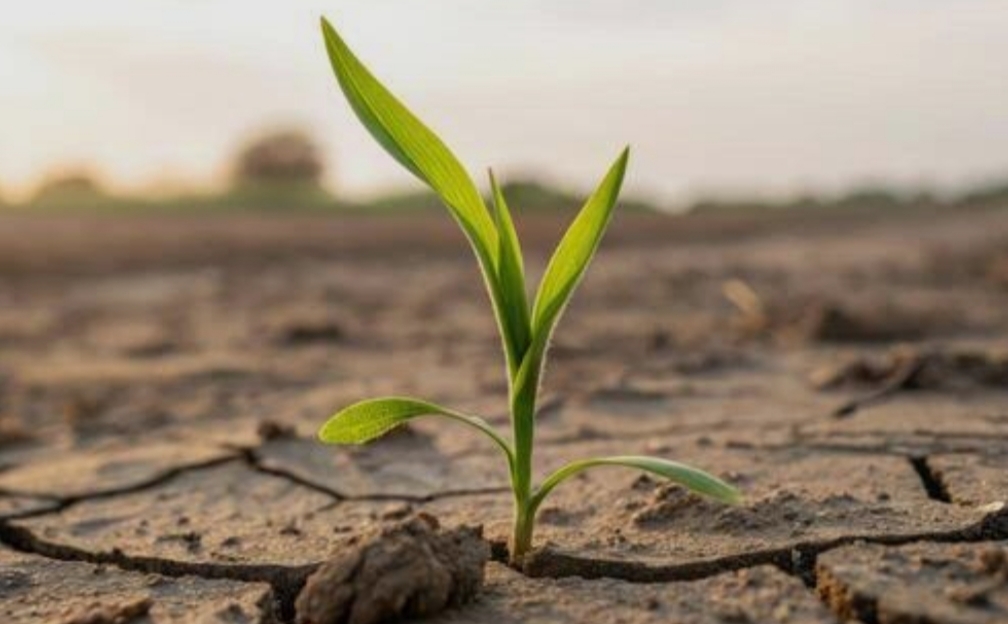
An Economy Adapting in the Shadows
By Tonderai Godknows Mapfumo
HARARE – IT IS just after six in the morning in a Harare suburb, and a vegetable vendor is already rearranging her stall. The rains failed again this season, and the tomatoes she used to buy cheaply from nearby growers are now scarce and expensive. So she has shifted — smaller batches of tomatoes, more onions and leafy vegetables that need less water to grow, and a new supplier three bus fares away who can still deliver reliably. No government program funded the shift. She adjusted because she had to, and because staying still would have meant losing her livelihood entirely.

Multiply her by the hundreds of thousands of unregistered traders, vendors, and micro-enterprises across Zimbabwe’s cities, and a striking pattern emerges: the informal sector is quietly absorbing the country’s climate shocks, one small decision at a time — while remaining almost completely invisible to the policies and programs designed to build “climate resilience.”
The Hidden Giant of Zimbabwe’s Economy
Zimbabwe’s informal sector is enormous — by some estimates, it accounts for the large majority of urban employment. These are the vendors, transporters, artisans, and small manufacturers who operate without formal registration, tax numbers, or access to bank credit. They are also, by definition, largely absent from the data that shapes climate and economic policy. When droughts, floods, or extreme heat disrupt supply chains and demand, these firms are rarely surveyed, rarely funded, and rarely mentioned in adaptation strategies.
And yet they adapt constantly. In conversations with traders across Zimbabwean urban markets, the strategies that emerge are remarkably consistent:
· Diversifying stock. Vendors shift what they sell in response to availability and affordability, spreading risk across multiple product lines rather than depending on a single crop or good. This tactic is used across the informal economy to stabilise earnings and cope with seasonality or extreme weather.
· Shifting hours and locations. Traders move to avoid extreme heat, flooded routes, or disrupted transport corridors, adjusting where and when they operate almost daily. In Harare, where summer temperatures now regularly exceed 38°C, vendors report reducing their rounds and travel distances — adaptations made for health reasons that can reduce income by up to a quarter.
· Informal savings and credit circles. Rotating savings groups — often called mukando — allow traders to smooth out income shocks without ever touching a bank. When a climate shock wipes out a week’s earnings, these informal financial networks are often the only buffer available. Women-led savings groups have created local-level climate financing, building on revolving funds that provide opportunities for adaptation and disaster risk reduction.
· Flexible, low-overhead business models. Because these firms carry little fixed capital or infrastructure, they can pivot quickly — closing one line of business and opening another within days, something formal firms rarely manage.
None of this is accidental. It is a rational, tested response to operating in a country where formal safety nets, insurance, and credit are largely unavailable to the majority of economic actors. In this context, informality is not a sign of backwardness — it is a survival strategy refined over years of economic instability, and it appears remarkably well-suited to climate volatility as well.
The Health Toll: Heat as an Occupational Hazard
While these adaptive strategies demonstrate resilience, they come at a significant human cost. Recent research in Bulawayo indicates that land use changes have driven a pronounced warming trend, with summer land surface temperatures reaching 43.4°C. This thermal amplification is not merely an abstract climatic phenomenon but a direct determinant of public health. A survey of 150 street traders found that nearly all (98.7%) reported heat-related symptoms such as headaches, while 63.3% experienced fainting spells. As one vendor in Harare described: “When it’s hot, customers stay under shade or in their cars. I sit in the sun. My back aches, but if I stop, I lose money.”
The burden is disproportionately carried by women, who dominate food and produce vending. They face long hours outdoors while also shouldering unpaid care work at home. In a city where water supplies are rationed, many go days without running water, compounding the challenges of heat stress and hygiene. Women in informal settlements often lack secure land tenure and are frequently excluded from planning processes, limiting their access to climate adaptation measures.
The Irony of “Resilience” Policy
Here is the uncomfortable part: climate adaptation funding and policy attention in Zimbabwe — and across much of the developing world — tends to flow toward formal, registered firms. These are the businesses that appear in government statistics, can produce the paperwork donors and ministries require, and are “legible” to the systems designing resilience programmes.
However, legibility is not the same as vulnerability, nor is it the same as capability. Many formal firms, weighed down by fixed premises, regulatory obligations, and less flexible operating models, are often slower to adjust when a shock hits. The informal traders who are arguably the most exposed to climate risk — with no insurance, no credit line, and no government department overseeing their welfare — are frequently the ones adapting fastest, precisely because they have no choice and no cushion to fall back on.
This inverts the usual policy assumption that informality equals fragility and formality equals resilience. In Zimbabwe’s current context, the opposite may be closer to the truth: informal firms have built resilience out of necessity, while formal firms are protected mainly on paper.
Grassroots Innovation: Youth and Women Leading the Way
Despite systemic neglect, grassroots initiatives are emerging that demonstrate the potential of locally led adaptation. In Bulawayo, young people are turning to climate-smart farming — mushroom cultivation, vegetable gardens, poultry production, and beekeeping — which require less water and adapt better to fluctuating weather patterns. Pastor Muziwanele Ncube’s co-operative, Deep Plough Agriculture Co-operative Society Limited, now has 65 members who use repurposed waste materials and indoor growing techniques to protect crops from extreme heat.
Women are central to these initiatives. In Bulawayo’s Ward 17, women grow vegetables, process food, and sell produce at local markets, simultaneously supporting household income and strengthening leadership and business skills. Community-led savings groups have become a critical mechanism for grassroots climate change governance, with over 500 women-led groups creating local-level climate financing.
What This Means for Policy
None of this is an argument that informal traders do not need support, or that informality should be celebrated for its own sake. Operating without registration carries real costs — no legal protection, no access to formal credit at reasonable rates, and constant vulnerability to harassment or eviction from municipal authorities. Studies of informal workers in Harare and Masvingo show that extreme weather events impose heavy economic costs, leading to escalating debts and erosion of assets that are especially unmanageable for the poorest city dwellers.
However, it is an argument for a different starting point. Rather than treating formalisation as a prerequisite for support — register first, then qualify for assistance — policy could recognise and work with the adaptive capacity that already exists in the informal sector:
· Lower the cost and friction of registration. Instead of making it a gatekeeping requirement, governments could create simpler, more accessible pathways to formalisation that do not require extensive paperwork or financial resources.
· Recognise informal savings groups and trader networks. These are legitimate financial infrastructure worth strengthening, not replacing. By blending community savings with international funds, organisations such as Dialogue on Shelter and the Zimbabwe Homeless People’s Federation have established city funds in Harare, Bulawayo, and Masvingo that provide loans for locally led adaptation initiatives.
· Collect better data on informal economic activity. Climate policy must stop designing around firms it can see while ignoring the ones doing most of the adapting. Gender-disaggregated data is essential — women face disproportionate burdens and require targeted support.
· Invest in infrastructure that supports informal traders. This includes water points, shaded marketplaces, and cooling facilities — investments that researchers across Zimbabwe’s cities have consistently recommended. As the Bulawayo study demonstrates, strategic urban greening and provision of shade infrastructure are evidence-based measures for protecting vulnerable populations.
· Create inclusive policy spaces. The Urban Informality Forum in Harare, established in 2018, has created a platform for neutral conversations where communities, the state, and civil society can discuss what is not working within the city without adversarial confrontation. Such spaces have led to tangible outcomes, including road designs for flood-damaged communities where residents have already started contributing savings.
Conclusion: Resilience That Already Exists
Back at the vegetable stall, the vendor has already moved on to her next customer. She will make another small adjustment tomorrow, and the day after that, without any policy ever noticing. The resilience Zimbabwe’s cities need is not something to be built from scratch — much of it already exists, in the daily decisions of people the system was never designed to see.
The challenge now is whether policymakers will begin to see them. Whether climate adaptation strategies will stop treating informality as a problem to be solved and start recognising it as an asset to be strengthened. Whether the ingenuity that keeps Zimbabwe’s cities functioning through drought, flood, and economic crisis will finally be acknowledged and supported.
The informal sector is not waiting for permission to adapt. It already is. The question is whether the rest of the system will catch up.
Tonderai Godknows Mapfumo is the Research and Advocacy Officer for COMALISO (Coalition for Market and Liberal Solutions) in Zimbabwe and an Associate of the Free Market Foundation.
Discover more from Etimes
Subscribe to get the latest posts sent to your email.