


By Jabulani Simplisio Chibaya
The control that runs at 2am
HARARE – A FRAUD model on a mobile money switch is retrained overnight, pushed through an emergency pipeline, and starts approving payments before anyone signs off. Nothing crashes. Months later, nobody can say which model version approved which transaction. (Illustrative, not a reported incident.)

That is how an IT General Control failure looks in a real-time estate. ITGCs were built for batch worlds, where someone reviewed last night’s run each morning. Streaming removes the morning: decisions land in milliseconds, so controls must execute in milliseconds, and evidence must be a by-product of operation, not a project before the audit.
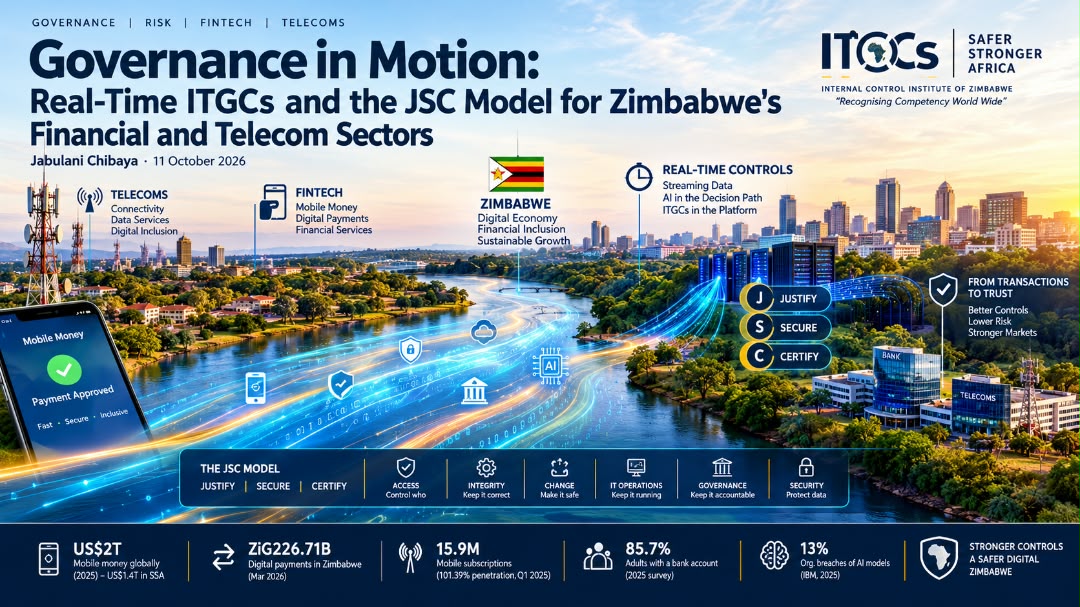
This article extends the JSC model (Justify, Secure, Certify) to Zimbabwean banks, fintechs, mobile money operators and telcos running Kafka, Flink or Pulsar with AI in the decision path. The six ITGC domains still hold. What changes is where they live: in the platform, written as code, enforced continuously.
Why this sector, and why now
Zimbabwe’s financial and telecom rails already run at streaming scale, and they are about to carry AI.
Scale. Mobile money moved over US$2 trillion worldwide in 2025, about US$1.4 trillion of it in Sub-Saharan Africa (GSMA, via ConnectingAfrica). RBZ data put Zimbabwe’s digital payments at ZiG226.71 billion (US$8.96 billion) in March 2026, at 74 to 76 million transactions a month in early 2026 (Newsday). POTRAZ counted 15.9 million active mobile subscriptions (101.39% penetration) in Q1 2025 (Herald), and data services were 47.97% of mobile operator revenue in Q2 2025 (MEA Tech Watch).
Shape. In RBZ’s Q4 2023 report, retail channels carried 195.37 million of 198.17 million electronic transactions (98.6%) while RTGS carried 62% of value (shares are my calculations) (Herald). Many small, fast events is exactly the workload where streaming and AI sit.
Behaviour. In a 2025 survey of 205 urban respondents, 85.7% held a bank account and 76.6% said they adapt to banks’ technology changes [1]. Customers adopt faster than controls mature.
Risk. IBM’s 2025 study found 13% of organisations reported breaches of AI models or applications, 97% of those lacked proper AI access controls, and 63% of the 600 organisations studied had no AI governance policy (IBM). The BIS finds AI mostly intensifies existing risks: model risk, data governance and third-party dependency [2].
Law. Zimbabwe’s National AI Strategy 2026-2030 lists finance and insurance as target sectors (OECD.AI), but one legal commentary notes a strategy is not a statute: it creates no enforceable duties, while the Cyber and Data Protection Act already bites on automated decisions (Africa Law Matters). ITGC evidence is the enforceable common denominator.

Technical anatomy: where ITGCs live in Kafka, Flink and Pulsar
Each ITGC domain maps to specific settings an auditor can check.
Kafka
- Access: TLS or mTLS plus SASL; ACLs per principal on topics, consumer groups and transactional.id; one principal per service, no wildcards.
- Integrity: acks=all, min.insync.replicas=2, idempotent producers, and transactions read with read_committed give effectively-once writes, so a payment is not applied twice.
- Change: registry compatibility rules (backward or full) reject breaking schema changes in CI. Money is a decimal or integer minor unit, never a float, with currency and exchange-rate version in every event, because ZiG and US$ coexist.
Pulsar. Tenants and namespaces map access boundaries to business lines or subsidiaries, with JWT or mTLS authentication, built-in schema enforcement, per-namespace geo-replication and tiered storage. Flink reads both Kafka and Pulsar.
Flink. Checkpoints use asynchronous barrier snapshots that capture operator state at low overhead [3]; with two-phase-commit sinks they give end-to-end exactly-once. Controls that matter: externalised checkpoints in object storage, a savepoint before every upgrade, explicit operator uid() so state survives code changes, event-time watermarks with a late-data side output into the audit log, state TTL for privacy retention, and broadcast state to push sanctions lists and limits without redeploying. Flink CEP can flag AML typologies such as structuring across sub-threshold transactions.
Capacity tests belong in the operations control, because windowed throughput and latency differ across Storm, Spark and Flink [4]. Document each stream like a dataset: motivation, composition, collection process, recommended uses [5].
The JSC model: Justify, Secure, Certify
Justify (before any model touches a stream). Register the use case with an owner, data sources, decision rights and a kill-switch, then assign a risk tier. Tier 1 advises. Tier 2 recommends and a human approves. Tier 3 acts on money, credit or customer rights. The tier sets how many gates a decision must pass.
Secure (while building and running). Extend the six ITGC domains to streams and models:

Certify (continuously). Each control emits its own evidence as an event. Tier 3 systems are re-certified on a fixed cycle, independently reviewed, and reported to the board on one page, with the same evidence reused for the external auditor, RBZ, SECZim, POTRAZ and the FIU.
Orchestration makes governance real
A policy in a PDF is a hope. Governance becomes real when the pipeline refuses to run without it, at three points.
1. Before deploy. Policy-as-code (Open Policy Agent rules, for example) blocks a release unless the schema is compatible, the ACL diff is approved, the model card and dataset datasheet exist [5], tests pass and the use case is registered. Deploying from Git through an orchestrator such as Argo CD or the Flink Kubernetes Operator means the approved commit is the running system.
2. In the stream. Gates run before a model’s answer takes effect. Santander AI Lab’s open-source mech_gov framework (Apache-2.0, v0.1.0, June 2026) is the clearest public pattern: hard gates, candidate freezing, an argument-quality check, an ambiguity gate that defers to a human, and a privacy gate that tokenises identifiers and fails closed. An arXiv study tests the same contrast in a synthetic banking domain: text-only governance left 27% of deferrals without decision-relevant information, and mechanical enforcement cut that by 73% and lifted accuracy (MCC) from 0.43 to 0.88 [7]. Caveats: synthetic data, an early release, and no confirmed authorship link between the paper and the repository.
3. After the decision. Every outcome goes to an append-only decision log: event id, model and policy version, feature hash, gates triggered, human override. LLM judges can monitor it, but small on-premise judges matched ground truth only 51.5% to 69.1% of the time in one 2026 study, with position bias of up to 25 points, so disagreement should route to a human [8].

Policy as code stops a bad release; gates stop a bad decision; the log lets audit, risk and the board see both.
Connecting operations, management and governance
Governance fails when the layers speak different languages. One signal should travel up the chain, translated at each level.

The three lines model fits: engineering owns controls, risk and compliance challenge, internal audit assures independently. Schuett shows how it closes coverage gaps and helps boards oversee management [9]. Auditing works best layered across the developer, the model and the application [10], so a bank using a foreign model API audits the vendor, the model’s behaviour on its data, and its own application separately.
What most organisations miss
- The control plane. Teams lock down topics but forget who can change ACLs, schemas, Flink jobs and Kafka Connect connectors. Connectors hold database credentials, and the Connect REST API is unauthenticated unless configured.
- Retention set by disk, not law. Align retention to regulatory duties, and use per-customer encryption keys (crypto-shredding) so an append-only log can still honour deletion.
- Replay is a change. Reprocessing history with a new model rewrites outcomes. Treat offset resets as privileged, approved changes.
- Silent failure. AI degrades without alarms. Test live features for dataset shift so the system fails loudly [6].
- Sampling a full population. A stream can be tested in full, with continuous control monitoring and an exceptions queue.
- Text-only policy. If the model interprets the rule, it can satisfy it cosmetically. Make hard limits code [7].
- Rubber-stamp humans. Measure the information content of escalations and the quality of overrides [7].
- Time and vendors. Audit trails need synchronised clocks, and foreign model APIs concentrate third-party, residency and exit risk [2].
Communicating findings to non-technical audiences
Lead with exposure, not architecture. One page per finding: risk, control, evidence, residual risk.
- Say it in money, time and rights. “For N minutes an unapproved model could approve payments up to X” lands; “a CI gate was bypassed” does not. Call the decision log a flight data recorder.
- IT audit. Report design effectiveness (would the control work?) and operating effectiveness (did it, across the period?). A stream lets you state the population as every event.
- Compliance. Map each control once to many obligations: the Cyber and Data Protection Act, FIU AML/CFT expectations, RBZ, SECZim, POTRAZ. South Africa shows the direction: banks’ due diligence is now risk-based and technology-integrated [11].
- Internal audit. Use vocabulary boards recognise: objectivity, privacy, transparency, accountability, trustworthiness, the five ethical challenges of AI in accounting and auditing [12].
- The board. Five questions. Which AI decisions move money without a human? Who can switch them off, and how fast? When did we last restore from backup? How many emergency changes this quarter? What would we show a regulator tomorrow?
- Proportionality. Stringent regulation is among the factors slowing Sub-Saharan banking growth [13], so automate evidence rather than add paperwork.
What’s next for Zimbabwe
- Register every Tier 3 decision within a quarter, each with an owner, kill-switch and gate set.
Report once, satisfy many. RBZ, SECZim, POTRAZ (as data protection authority) and the FIU agree a shared minimum control and evidence schema.
- Engineer for local conditions: cross-site replication, measured restore tests, and a rules-based fallback for power and link failures.
- Train hybrid people: engineers who understand audit evidence, auditors who can read a decision log.
- Close the statute gap deliberately. Until an AI law exists, treat Cyber and Data Protection Act compliance as the binding floor, and control maturity as a signal to investors, VFEX and ZSE counterparties.
The question for Zimbabwe is not whether AI will sit in the decision path of money. It is whether the controls will already be there.
References
- Kawara, A., Muchara, B., & van der Poll, H. M. (2025). Financial Inclusion in Zimbabwe: Lessons from the Commercial Banking Sector. International Journal of Financial Studies, 13(4), 182. doi:10.3390/ijfs13040182
- Crisanto, J. C., Leuterio, C. B., Prenio, J., & Yong, J. (2024). Regulating AI in the financial sector: recent developments and main challenges. BIS FSI Insights on policy implementation, No 63. bis.org
- Carbone, P., Fóra, G., Ewen, S., Haridi, S., & Tzoumas, K. (2015). Lightweight Asynchronous Snapshots for Distributed Dataflows. arXiv:1506.08603
- Karimov, J., Rabl, T., Katsifodimos, A., Samarev, R., Heiskanen, H., & Markl, V. (2018). Benchmarking Distributed Stream Data Processing Systems. IEEE ICDE 2018. arXiv:1802.08496
- Gebru, T., Morgenstern, J., Vecchione, B., Vaughan, J. W., Wallach, H., Daumé III, H., & Crawford, K. (2018, rev. 2021). Datasheets for Datasets. arXiv:1803.09010
- Rabanser, S., Günnemann, S., & Lipton, Z. C. (2018, rev. 2019). Failing Loudly: An Empirical Study of Methods for Detecting Dataset Shift. arXiv:1810.11953
- de la Chica Rodríguez, J. M., & Martí-González, C. (2026). Mechanical Enforcement for LLM Governance: Evidence of Governance-Task Decoupling in Financial Decision Systems. arXiv:2605.14744
- Dussert, J. (2026). Who judges the judges? Governance from metrics: a runtime framework for continuous LLM compliance monitoring. arXiv:2605.24737
- Schuett, J. (2023). Three lines of defense against risks from AI. AI & Society, 40(2), 493-507. doi:10.1007/s00146-023-01811-0 (preprint arXiv:2212.08364)
- Mökander, J., Schuett, J., Kirk, H. R., & Floridi, L. (2024). Auditing large language models: a three-layered approach. AI and Ethics, 4(4), 1085-1115. doi:10.1007/s43681-023-00289-2 (preprint arXiv:2302.08500)
- Gaviyau, W., & Sibindi, A. B. (2023). Anti-money laundering and customer due diligence: empirical evidence from South Africa. Journal of Money Laundering Control, 26(7), 224-238 (Emerald). doi:10.1108/jmlc-06-2023-0103
- Lehner, O. M., Ittonen, K., Silvola, H., Ström, E., & Wührleitner, A. (2022). Artificial intelligence based decision-making in accounting and auditing: ethical challenges and normative thinking. Accounting, Auditing & Accountability Journal, 35(9), 109-135 (Emerald). doi:10.1108/AAAJ-09-2020-4934
- Akinbowale, O. E., Zerihun, M. F., & Mashigo, P. (2025). Banking and financial regulation in Sub-Saharan Africa: a systematic literature review and multiple regression approach. Journal of Financial Regulation and Compliance, 33(3), 359-385 (Emerald). doi:10.1108/jfrc-09-2024-0170
Data and code sources (linked in the text, not counted above): GSMA 2026 via ConnectingAfrica; RBZ figures via Newsday and Herald; POTRAZ figures via Herald and MEA Tech Watch; IBM Cost of a Data Breach 2025; OECD.AI strategy entry; Africa Law Matters commentary; Santander AI Lab mech_gov repository and its open-source announcement.
Verification note: RBZ and POTRAZ figures are as reported by the press, not read from the regulators’ own publications. Reference details were checked against arXiv, Crossref and publisher records; [11] to [13] were checked at abstract level only.
Jabulani Simplisio Chibaya is a Data and AI Consultant specializing in data science, artificial intelligence, blockchain, and cryptocurrency innovation. A seasoned conference speaker, he also writes on the intersection of technology, regulation, and economic development. Contact: Cell: +263 778 921 881 | Email: simplisiochibaya22@gmail.com | LinkedIn: https://www.linkedin.com/in/jabulani-simplisio-chibaya
Discover more from Etimes
Subscribe to get the latest posts sent to your email.