


By Tinotenda Bhunu
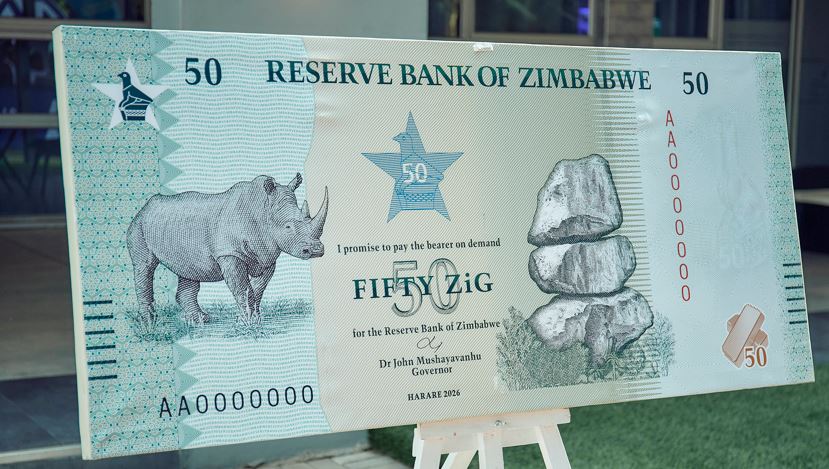
HARARE – THERE’S a peculiar moment in the life of a currency when the central bank starts telling you that you should trust it. The speeches get more confident. The charts get more reassuring. Inflation falls. The exchange rate stops lurching around quite so violently. New banknotes show up with nicer designs. Interest rates ease. Officials start reaching for words like “confidence” and “stability,” and eventually, they start asking the public to hand over the currency they actually trust for the one they’re being told to trust instead.
Zimbabwe may be nearing that moment.

The Reserve Bank of Zimbabwe’s August 2026 Mid-Term Monetary Policy Statement paints a considerably calmer picture than the one Zimbabweans have grown used to. ZiG inflation stood at 3.2% in July. The exchange rate has held within a fairly narrow band. Foreign-currency inflows rose sharply in the first half of the year, and reserves climbed to US$1.7 billion. The economy is projected to grow 5% in 2026. None of that is trivial.
But there’s a danger in mistaking stability for trust. A currency can be stable because the institutions behind it are credible, or it can be stable because the authorities are actively managing the conditions under which it trades. Those aren’t the same thing, and the difference matters a great deal if Zimbabwe intends to move from its current multicurrency setup toward a mono-currency system.
The most telling number in the whole statement, then, probably isn’t the inflation rate. It’s 50.1%, the Reserve Bank’s own weighted score of how far it’s come toward satisfying the conditions it has set for a mono-currency transition. The Bank is careful to note this isn’t a signal that transition is imminent, and that the process stays market-driven and conditions-based. Halfway there. But halfway to what, exactly?
That answer matters because a currency isn’t just paper, a digital balance, or a figure printed in a government gazette. It’s a social institution built on expectations. People accept money today because they believe someone else will accept it tomorrow. That belief can’t be legislated into existence, and Zimbabwe has learned this the hard way before. So the real question isn’t whether ZiG performed better in 2026. It did. It’s whether Zimbabwe has built the institutional foundations to make that performance durable once favourable conditions stop doing the heavy lifting. That’s where the numbers get more interesting.
Take the much-publicised US$1.7 billion in reserves. Sounds enormous, doesn’t it? For a person, it’s an almost unimaginable sum. For a country, though, the question isn’t whether US$1.7 billion is a big number. It’s how long that money can keep the economy supplied with foreign currency if things go sideways. The Reserve Bank itself says the figure represents only 1.7 months of import cover, roughly seven weeks’ worth of imports at current demand. That changes how you should read the headline. Zimbabwe has built up a real buffer compared to where it’s been, but it’s still thin. The Bank’s own benchmark for the transition is at least three months of cover, moving eventually toward six, and it currently expects to reach only 1.8 to two months by the end of 2026. Not a minor technicality. Foreign reserves are basically the emergency savings account of a monetary system, and the world doesn’t stop demanding foreign currency just because a government has declared confidence in its own. Zimbabwe imports fuel, machinery, pharmaceuticals, industrial inputs, technology, consumer goods, and when those bills come due, they get paid in a currency the supplier will actually accept. A currency doesn’t become strong just because its central bank wishes it so. The market has to believe it. And right now, the market is still talking.
The Reserve Bank says the parallel-market premium averaged around 15% over the first seven months of the year. The official rate held steady, sure, but a parallel price still existed alongside it, and that gap matters economically. If one market prices a dollar one way and another market consistently prices it 15% higher, the economy hasn’t landed on a single, universally trusted price for foreign currency. What it’s achieved instead is something messier: managed stability running alongside continued market differentiation. Which is exactly why the shift to a mono-currency ought to be treated as an economic outcome, not a political event. A government can announce a currency regime. It can’t announce away people’s preferences.
This is where the Austrian insight is useful. Money emerges from exchange because people value being able to trade with something others will accept; its usefulness is rooted in voluntary exchange, not official declaration. The state can grant a currency legal-tender status; it can’t force anyone to see it as a reliable store of value. It can make taxes payable in it; it can’t manufacture real savings demand. It can restrict the alternatives; it can’t stop entrepreneurs from pricing risk the way they see fit. That distinction ought to sit at the very centre of Zimbabwe’s currency debate.
There’s another uncomfortable figure buried in the statement. Broad money rose from ZiG108.09 billion in December 2025 to ZiG142.01 billion by June 2026, a 31.4% increase, or 45.9% year-on-year. And yet the Reserve Bank maintains that expansion has stayed within target and inflation remains low. No contradiction there, necessarily. Money-supply growth doesn’t automatically translate into an inflationary blowup; it depends on demand for money, velocity, production, expectations, fiscal policy, and how credible the institutions are. But that’s precisely the point. Zimbabwe no longer just needs to show that ZiG can survive a good stretch. It needs to show it can survive a bad one, because economies aren’t tested when things go right. They’re tested when commodity prices fall, when drought hits, when government spending accelerates, when inflows dry up, when confidence slips, or when some external shock suddenly sends people scrambling for dollars. The Reserve Bank itself flags the Middle East conflict, volatile commodity prices, and the anticipated super El Niño as downside risks. That’s where the real test starts. Zimbabwe has a long history of watching monetary stability vanish faster than it arrived.
So what happens when the environment gets less forgiving? The answer can’t just be “the Reserve Bank will step in.” The statement itself shows how much of today’s calm depends on constant intervention and liquidity management. Between January and 4 August, government spending pumped ZiG42.3 billion into the market, and Reserve Bank purchases of export surrender proceeds added another ZiG32.8 billion. Government revenue collection pulled out ZiG46.1 billion, and Reserve Bank foreign-currency sales pulled out ZiG26.9 billion. Net it all out and you still get a liquidity injection of ZiG4 billion. That’s not proof of failure. It’s proof of just how active the machinery still is. But a system that needs this much continuous calibration deserves real scrutiny before anyone declares it ready to be the economy’s sole monetary foundation.
Which brings us to the strongest part of the statement, not the confident language about stability, but the honest admission that the job isn’t finished. The Reserve Bank lays out eight conditions: inflation staying low for a sustained stretch, rising reserves, an efficiently functioning foreign-exchange market, a stable exchange rate, growing demand for ZiG, a stable financial system, efficient payments infrastructure, and fiscal discipline strong enough to avoid monetary financing of government. Sensible enough. But the logic carries an implication that’s easy to skip past: if these conditions are genuinely necessary, the transition should wait until they’re genuinely met. Not approximately met. Not politically convenient. Not because the calendar says it’s time, or because the government wants a symbolic win, or because officials are simply tired of running a multicurrency system. Money is too important for shortcuts like that.
There’s always a temptation in monetary policy to believe that the right institutional arrangement can conjure the underlying economic reality into being. History says otherwise. Institutions work when they reflect realities that already exist, not the other way around. If Zimbabweans hold ZiG willingly because they trust it to preserve value, settle transactions smoothly, and stay convertible when needed, then the currency has succeeded in the way that actually counts. If they hold it because they simply have no other choice, the apparent success is a lot flimsier than it looks. That’s the difference between currency substitution fading away on its own and currency substitution being suppressed. The first is a market achievement. The second is an administrative one. Zimbabwe should want the first.
And there is encouraging evidence on this front. ZiG-based transactions have climbed above 40%, with authorities hoping to reach 60% in the medium term. The government has also trimmed IMTT on ZiG payments from 2% to 1.5%, while holding it at 2% for US-dollar transactions, which creates a clear incentive to use local currency. But an incentive isn’t the same thing as a preference. A tax differential can shift behaviour without shifting belief. The real test is what people choose once the incentives disappear.
Which is why the proposed electronic foreign-exchange trading platform might end up mattering more than another round of currency promotion. The RBZ says it’s meant to improve price discovery, efficiency, and interbank trading, while cutting reliance on the central bank as the main broker of foreign-exchange deals. It’s expected to launch in the fourth quarter of 2026. That’s the right direction. A currency gets stronger when markets get freer and prices get more honest about scarce resources, not when the central bank gets better at hiding those prices. The goal shouldn’t be an obedient foreign-exchange market. It should be an honest one. If foreign currency is scarce, let the price say so. If it’s abundant, let the price say that too. If ZiG is genuinely competitive, let it compete. If people prefer to save in it, let their savings prove it. If businesses find it preferable for contracts and working capital, let their decisions show it. A currency that wins on its own merits doesn’t need to be propped up by decree.
Fiscal policy matters more than monetary policy over the long run, and this is why. The Reserve Bank names the absence of inflationary central-bank financing of government as one of its conditions, and that condition carries more weight than it might first appear to. A central bank can spend months building confidence in a currency, but if fiscal authorities eventually go back to financing deficits by printing money, that credibility can evaporate almost overnight. The temptation never really goes away. Governments face political pressures, and spending demands don’t vanish just because monetary policy has gotten disciplined. The real test of any monetary reform is whether fiscal discipline survives contact with politics. That’s where institutions matter more than intentions ever will.
There’s some reason for cautious optimism in the banking sector too. The Reserve Bank reports adequate capitalisation, strong liquidity, and a non-performing-loan ratio of 3.19%, below the 5% benchmark, with capital adequacy at 24.13% as of June 2026. Banks, in other words, are in reasonably good shape to channel savings into investment and extend credit without the strain that comes with a fragile system. But there’s a contradiction sitting right underneath that: the Reserve Bank itself notes that the gap between its 30% Bank Policy Rate and average lending rates has grown wide enough to price productive sectors out of formal credit. This is exactly where monetary stability needs to start translating into real investment. Low inflation on its own isn’t enough. Money has to be available at rates businesses can actually afford, or stability just stays a line on a chart instead of becoming an engine for growth.
This is the distinction that gets lost in a lot of Zimbabwe’s currency debate. Monetary stability isn’t there to produce nice-looking central-bank charts; it exists to create conditions where people can plan, save, invest, borrow, produce, and trade. The real prize isn’t a lower inflation number. It’s turning that stability into actual economic activity. Businesses invest when they believe prices will hold. Households save when they believe their savings will keep their value. Banks lend longer when they trust the currency. Investors commit capital when they believe the rules won’t shift under them. And when all of that happens voluntarily, the currency starts to acquire something no central bank can manufacture by decree: trust. That’s why Zimbabwe should resist the urge to mistake a good run for a finished reform.
The current numbers are genuinely encouraging, but they also spell out exactly what’s still unfinished. US$1.7 billion in reserves isn’t just a big number; it’s 1.7 months of import cover. A 3.2% inflation rate isn’t just a statistic; it’s a stretch of time in which purchasing power is eroding slowly enough for people to plan with some confidence. A 45.9% annual jump in broad money isn’t automatically a crisis; it’s a test of whether confidence and economic activity can keep absorbing that expansion without eventually spilling over into inflation or exchange-rate pressure. A 15% parallel-market premium isn’t proof the system has failed; it’s evidence the market still knows something the official rate hasn’t fully caught up to. And a 50.1% conditions score isn’t a countdown to mono-currency. It’s a reminder that halfway isn’t the destination.
Zimbabwe has genuinely achieved something in 2026: more monetary stability than it’s used to. The harder task now is making that stability credible enough that people stop needing to be talked into trusting the currency. You can’t get there with slogans, new banknotes, or legislation. It has to be earned, through sound money, disciplined government, functioning markets, adequate reserves, credible institutions, and the freedom for people to make their own economic choices.
Ludwig von Mises understood something central bankers keep forgetting: money isn’t a creation of the state, it’s a creation of the market. The state can intervene in the system, but it can’t repeal the laws of human action that shape how people value, save, and exchange. When Mises wrote about the regression theorem, he argued that money’s value today rests on expectations of its value tomorrow, which in turn rest on its value yesterday, a chain that can’t be broken by decree. It has to be built through experience.
Zimbabwe’s problem has never really been a shortage of monetary ambition. It’s been a shortage of monetary humility. The country has tried, again and again, to leap from institutional weakness straight to monetary strength through sheer force of official declaration. And every time, the market has delivered the same verdict: trust can’t be commanded. It has to be earned.
Which is probably why the surest path to a successful mono-currency is to stop trying so hard to force one into existence. Let ZiG earn its monopoly through performance. Let it compete for trust. Let entrepreneurs, workers, savers, and investors decide for themselves. Because in the end, a currency isn’t made strong by how many laws protect it; it’s made strong by how many people would choose it even if the law didn’t make them. That’s the currency Zimbabwe should want. And it’s a test the ZiG hasn’t passed yet.
Tinotenda Bhunu is an economist by profession. LinkedIn: https://www.linkedin.com/in/tinotenda-bhunu-114645208?utm_source=share&utm_campaign=share_via&utm_content=profile&utm_medium=android_app
Discover more from Etimes
Subscribe to get the latest posts sent to your email.