


A Political Economy of War, Fertilisers and Food Security in 2026
By Newton M. Mambande
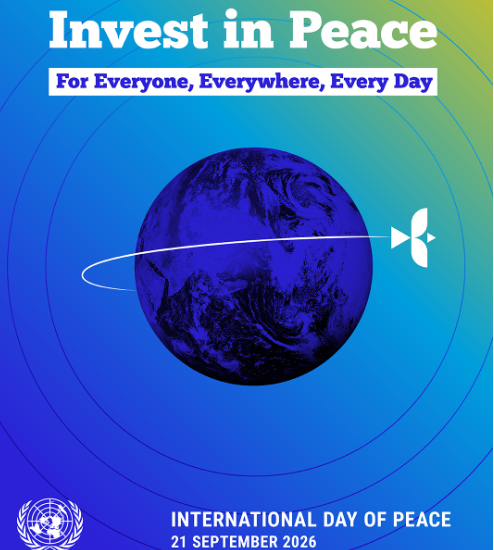
HARARE – ON 21 September 2026, the world commemorates the 45th International Day of Peace under the theme declared by the United Nations General Assembly: “Invest in Peace: For Everyone, Everywhere, Every Day.” The United Nations Secretary-General, in ringing the Peace Bell at UN Headquarters, reminded the world that peace is more than the absence of war. It is the lived experience of safety, dignity, opportunity and cooperation in daily life. It honours what the UN calls the everyday architects of peace – people at grassroots level building stability from the ground up.

This column is written from the perspective of economics and economic history. It argues that peace is not a sentimental aspiration but the most productive form of capital. War is the most destructive form of disinvestment.
THE TWO WARS TAXING THE WORLD ECONOMY IN 2026
In 2026, the global economy is simultaneously absorbing two systemic military shocks.
The first is the protracted Russo-Ukrainian war, now in its fourth year. Its economic footprint is well documented. Russia and Belarus account for approximately 30 percent of global potash and nitrogen exports, while Ukraine and Russia combined historically supplied 28 percent of world wheat exports. The Black Sea blockade and sanctions regime of 2022 created the template for food price inflation that pushed 47 million people into acute hunger.
The second, and more acute shock for 2026, is the United States-Israel-Iran War that began on 28 February 2026 with US-Israeli airstrikes on Iran. Iran’s response was the near closure of the Strait of Hormuz. The Strait is not a distant waterway. It is the jugular of the global economy, through which approximately 20 percent of the world’s traded oil and significant volumes of liquefied natural gas flow, and roughly 33 percent of the world’s traded seaborne fertiliser.
Within days, Brent crude surged from roughly US$70 per barrel to over US$110, the highest level since Russia’s 2022 invasion. Spot-month US Gulf urea, the nitrogen fertiliser price benchmark, rose 32.5 percent for the month and 76 percent from its early December 2025 low. Urea prices moved from US$492 to US$530 per tonne almost immediately, with Diammonium Phosphate projections toward US$1,000 per tonne. The World Bank’s fertiliser price index rose more than 12 percent in the first quarter of 2026 alone, marking its sixth increase in seven quarters.
For Zimbabwe, and for my own enterprises in Chimanimani, these are not abstract numbers. They are diesel at the pump. They are Compound D at Farm and City.
THE TRANSMISSION MECHANISM: FROM MISSILES TO MEALIE MEAL
How and why do these conflicts impact economic growth and development, investment promotion, crude oil, fertiliser and food security? Economic history provides a clear transmission chain.
First, energy as feedstock. Natural gas and liquefied natural gas are the critical feedstock for producing ammonia, the base input for urea. When crude oil and LNG prices rise, fertiliser production costs rise directly. Regional security tensions simultaneously drive up maritime shipping and tanker insurance costs. Approximately 0.8 million metric tons of fertilisers and precursors are estimated to be removed from the market each month if the Strait of Hormuz is closed.
Second, cost-push inflation. Purdue University’s assessment in March 2026 noted that the closure had driven crude above US$110 and nitrogen fertiliser up more than 30 percent – a severe shock arriving at the worst possible time for spring planting. Michigan State University’s working paper 0301-2026 concluded that the war has increased the cost of farming, and food prices will also increase primarily due to higher oil and diesel prices driving up transportation costs throughout the food supply chain. CoBank estimated an additional US$2,000 in fuel costs per farmer in the US alone.
Third, investment freeze. War creates what economists call the FOIL effect – Fear Of Inflation Long-term. Capital becomes risk-averse. Foreign direct investment retreats to safe havens. In Zimbabwe, where we require long-term capital for irrigation, cold chains and processing plants, global risk premiums increase our cost of capital. Projects are delayed. As Rabobank’s semi-annual outlook warned, fertiliser affordability has reached the lowest point in 18 years, with prices expected to remain elevated until 2027.
Fourth, food security and nutrition. This is the terminal impact. When fertiliser prices rise 30 percent, smallholder farmers, who produce 70 percent of Zimbabwe’s food, reduce application rates. Yields fall by 15 to 20 percent. Grain supplies tighten, supporting output prices but reducing caloric availability. India, which saw urea imports rise 85.3 percent to 8 million tonnes during April-December 2025-26, now faces a widening gap between domestic supply and consumption. For Zimbabwe, which imports 60 percent of its fertiliser precursors, the implication is direct: higher bread prices, higher chicken feed prices, higher poverty.
ZIMBABWE: A CASE STUDY IN RESILIENCE – LEARNING FROM THREE GLOBAL SHOCKS
Why then can Zimbabwe claim to have a resilient economy capable of withstanding global shocks? The answer lies not in propaganda but in economic history. Resilience is learned behaviour, forged in prolonged adversity.
The first lesson is World War II from 1939 to 1945. Southern Rhodesia, as Zimbabwe was then known, was cut off from traditional imports. The colonial state, under Godfrey Huggins, implemented import substitution industrialisation. Factories that made blankets and biscuits were established in Bulawayo and Salisbury. The Rhodesian Iron and Steel Commission was born. Farmers moved from tobacco to maize to feed the Allied forces. The economy learned to produce what it could not import.
The second, and most formative lesson, was the United Nations mandatory economic sanctions and trade embargo against the Unilateral Declaration of Independence (UDI) Rhodesia under Ian Douglas Smith from 1965 to 1979. This remains one of the most comprehensive sanctions regimes in modern economic history. Rhodesia lost access to London capital markets, to the Sterling Area, to formal oil supplies. Yet GDP grew at an average of 4.2 percent per annum between 1965 and 1974. How? Through three mechanisms that economic historians like Giovanni Arrighi and Colin Stoneman documented: first, import substitution deepened – Rhodesia produced its own fertiliser at Sable Chemicals, its own steel at ZISCO, its own clothing at David Whitehead; second, sanctions-busting trade via South Africa and Mozambique created parallel logistics; third, forced savings – because luxury imports were banned, domestic savings financed domestic investment. The sanctions economy was unjust and unsustainable politically, but it bequeathed physical capital – factories, dams, research stations – that Zimbabwe inherited in 1980.
The third lesson is COVID-19 from 2020 to 2022. When global supply chains collapsed, Zimbabwe’s informal sector and smallholder agriculture provided the buffer. While global GDP contracted by 3.1 percent in 2020, Zimbabwe’s agricultural sector, driven by Pfumvudza and command agriculture, recorded growth. Community resilience, diaspora remittances and gold small-scale mining kept foreign currency flowing when formal exports collapsed.
Together, these three shocks taught Zimbabwe what development economist Albert Hirschman called “linkage economics” – forward linkages from agriculture to processing, backward linkages from processing to agriculture, and lateral linkages into transport and finance.
HOW ZIMBABWE MUST CAPITALISE ON THE CURRENT CRISIS – LESSONS FROM ECONOMIC HISTORY
If peace is an investment, as the 2026 theme urges – “Invest in Peace: For Everyone, Everywhere, Every Day” – then Zimbabwe must invest counter-cyclically when others disinvest. Economic history provides notable cases.
First, the Danish case after the Napoleonic Wars. Denmark lost its fleet and its Norwegian territory in 1814 and faced bankruptcy. It invested in agricultural education, cooperatives and dairy processing. By 1880, Denmark had become Europe’s butter exporter. Lesson for Zimbabwe: invest in agricultural education and out-grower schemes now, when fertiliser is expensive, to build efficiency for when prices fall.
Second, the Japanese case after World War II. Japan, under sanctions and devastation, invested in quality circles and small-scale manufacturing. Lesson for Zimbabwe: our Tomato Sauce (375ml, 750ml, 2L) must focus on quality and import substitution. Every bottle of tomato sauce we produce locally saves foreign currency and insulates us from a Hormuz closure.
Third, the Israeli case – drip irrigation under siege. Israel, facing oil shocks in 1973, invested in water-efficient agriculture. Today it is a net food exporter in a desert. Lesson for Chimanimani: we must invest in solar-powered drip irrigation along our rivers, rather than rain-fed farming models that have historically failed in our region due to water insecurity.
Fourth, the Brazilian case during the 1970s oil crisis. Brazil invested in ethanol from sugarcane to reduce oil dependence. Lesson for Zimbabwe: accelerate lithium beneficiation and bio-fertiliser production using local phosphate from Dorowa and organic waste, reducing dependence on Gulf urea.
Practically, this means four actions for Zimbabwe in 2026/2027:
1. Invest in local fertiliser production. Revive Sable Chemicals through green hydrogen, exploit Dorowa phosphate, and promote organic compost through collection centres. This reduces exposure to DAP at US$1,000 per tonne.
2. Invest in strategic grain and fuel reserves. The economic history of UDI shows that reserves are a form of insurance premium. The Grain Marketing Board and NOIC must be capitalised.
3. Invest in peace as economic infrastructure. The UN theme correctly states that peace must be experienced in homes, schools, workplaces, neighbourhoods and markets. For investors, peace is contract enforcement, policy consistency and protection of property rights. Investment promotion fails when peace is not invested in daily.
4. Invest in the everyday architects of peace – our farmers, our factory workers, our cooks and cleaners, our out-growers in Chimanimani and Chiredzi. As this paper has shown, global fertiliser prices will eventually produce enough commodity price response to preserve net farm income if the conflict is short, but duration is everything – a prolonged closure would be unmanageable. Therefore, Zimbabwe must shorten its own vulnerability duration by producing its own inputs.
CONCLUSION
On this International Peace Day 2026, we must remember that peace is not merely the silence of guns in Gaza, in Tehran or in Donbas. Peace is the sound of a tomato sauce bottle sealing in Mutare, a farmer planting with affordable fertiliser in Chimanimani, a child eating nutritious porridge without fear of price spikes.
The US-Israel-Iran war and the Russo-Ukrainian war have shown that globalisation without resilience is fragility. Zimbabwe, having survived World War II disruptions, having built factories under total UN sanctions against UDI Rhodesia, and having survived COVID-19 supply chain collapse, has the historical muscle memory to survive this shock.
But survival is insufficient. As economists from Adam Smith to Amartya Sen taught us, crisis is the mother of import substitution and innovation. Let us therefore invest in peace for everyone, everywhere, every day – by investing in our farms, our factories and our people.
Invest in peace is not a slogan. It is the highest returning investment in the food security sector.
Newton M. Mambande is an entrepreneur, farmer and author. He has published scientific research scholarship in peer-reviewed journals in economics, economic history and business management. He is reachable at newtonmunod@gmail.com or +263773411103.
Discover more from Etimes
Subscribe to get the latest posts sent to your email.