


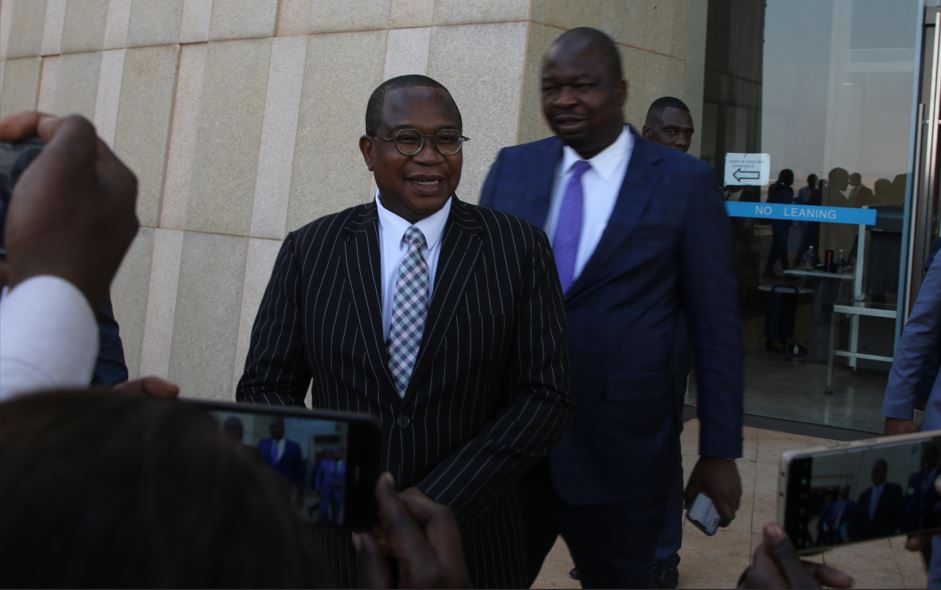
Professor Mthuli Ncube’s 2027 Budget, Read as Economic History, Financial Economics and a Test of National Resilience
By Newton M. Mambande
HARARE – EVERY national budget is, in one sense, a dull document: a list of numbers, a schedule of taxes, and a forecast that will almost certainly be wrong in detail. In another sense, it is one of the most revealing documents a country produces. It shows what a government fears, what it hopes for, and how it understands the world in which it must survive.

Professor Mthuli Ncube’s 2027 National Budget, presented to Parliament on 19 November 2026 under the theme “Accelerating Economic Transformation and Building Resilience to Climate and Global Shocks”, deserves to be read in that larger sense. It is an attempt to answer a question that has haunted Zimbabwe for more than a century: how does a country whose prosperity rises and falls with the rain, with the price of gold, tobacco and lithium in London, New York and Shanghai, and with the confidence of strangers, build an economy that can withstand a bad season and a bad world at the same time?
The headline numbers are now familiar. Expenditure is proposed at ZiG358.3 billion, about US$12.8 billion, or 18.6 per cent of gross domestic product. Revenue is projected at ZiG349.5 billion, about US$12.5 billion, or 18.1 per cent of GDP. The deficit is ZiG8.8 billion, or 0.5 per cent of GDP. Growth is projected to moderate to 3.5 per cent in 2027, from an estimated 5 per cent in 2026 and 8.3 per cent in 2025. The International Monetary Fund, cited by the Minister, projects global growth moderating to 3.1 per cent in 2026 before recovering to 3.4 per cent in 2027.
Those numbers do not, on their own, tell us whether this is a good, cautious, timid or brave budget. For that, we need a framework. A balanced analysis must do three things at once. It must place the Budget in economic history, because present choices are constrained by past debts, droughts and disappointments. It must apply financial economics, because a budget is a portfolio of risks, a statement about the price of money, the cost of borrowing, and the credibility of the currency. And it must ask the practical question that matters to a farmer in Chimanimani, a teacher in Gweru, a manufacturer in Bulawayo and a vendor in Harare: will this make food more secure, work more available, and life more predictable?
This column attempts that reading, with attention to five tests: food security and rural development; climate resilience and adaptability; trade and tariffs with the United States, the United Kingdom and Western Europe, and Asia; investment promotion and economic development; and economic growth itself.
1. The Historical Lens
No finance minister starts with a blank page. Professor Ncube starts with a history that is unusually heavy: land reform in the early 2000s, hyperinflation in 2007–08, dollarisation in 2009, the reintroduction of a local currency, the introduction of the ZiG, and a long struggle with external debt arrears. The underlying story is the same: without credible institutions, stable money and diversified production, growth is fragile.
That history explains two features of this Budget. The first is its conservatism on the deficit. A deficit of 0.5 per cent of GDP is small by international and Zimbabwean historical standards. The Minister presented it deliberately as a choice: “The anticipated fiscal deficit of ZiG8.8 billion, equivalent to 0.5% of GDP, reflects Government’s deliberate choice to scale up capital and social expenditure.” In financial economics, the deficit is not merely a gap to be financed. It is a signal. A government that borrows modestly, in a country with a history of borrowing immoderately, is trying to buy credibility. Credibility lowers borrowing costs, steadies the exchange rate, and anchors inflation expectations.
The second is its preoccupation with buffers. Total public and publicly guaranteed debt stood at an estimated ZiG594.1 billion, or US$22.2 billion, or 33.4 per cent of projected GDP, at the end of September 2026. That ratio is not unmanageable by global standards, but Zimbabwe’s debt is different in kind. A substantial portion is in arrears, owed to creditors who will not lend afresh until old obligations are addressed. A country in that position cannot borrow its way out of a shock as the United States or the United Kingdom can. It must self-insure. Hence the ZiG10.9 billion, about US$400 million, contingency buffer, financed from 2026 reserves. It is an attempt to build, in miniature, what richer countries take for granted: fiscal space.
A balanced judgement must acknowledge progress without mistaking it for arrival. Growth of 8.3 per cent in 2025 was the fastest in the Southern African Development Community and the second fastest in Africa, according to Treasury. Yet Zimbabwe has grown rapidly before, and then lost the gains. Growth driven by a good rainy season and a high gold price is not the same as growth driven by higher productivity, deeper manufacturing and more reliable institutions. The Budget’s central gamble is that the second kind can be built while the first is temporarily weakening. That is the right gamble. Whether it wins depends on implementation.
2. Financial Economics: Money, Tax and Risk
A useful way to read any budget through financial economics is to ask four questions. What does it do to the price of money? What does it do to incentives? What risks does it transfer, and to whom? What does it reveal about credibility?
On the price of money, the Budget is deliberately quiet. It does not attempt to force interest rates down or monetise expenditure. Recurrent expenditure is ZiG284.7 billion; capital expenditure is ZiG73.6 billion, rising from 2.3 per cent of GDP in 2026 to 3.8 per cent in 2027. In a country where the temptation has often been to fund recurrent consumption by borrowing, a shift towards capital spending is, in principle, correct. Capital spending, if well chosen, creates assets: dams, roads, irrigation, schools, clinics, power lines. The risk is execution. According to the Budget Statement, ministries submitted bids totalling ZiG974 billion, nearly three times the available envelope. A dam that is half-built is not an asset. It is a liability with a fence around it.
On incentives, the Budget is notably generous. It announces no new taxes and no increases, only relief. From 1 January 2027, the personal income tax-free threshold rises from US$100 to US$150 per month, with relief estimated at US$81 million. The Intermediated Money Transfer Tax falls from 1.5 per cent to 1.25 per cent on ZiG transactions, and from 2 per cent to 1.75 per cent on foreign currency transactions. Treasury will return US$120 million to economic agents through the IMTT cuts.
In financial economics, a tax cut is a change in relative prices. Lowering the IMTT reduces the cost of using the formal financial system. That matters enormously where informality is not a fringe activity but a central feature of daily life. Every percentage point of IMTT is, in effect, a tax on being visible to the state. When that tax is high, rational people stay invisible: they transact in cash, avoid banks, and keep savings in foreign currency or under the mattress. Lowering it is an attempt to widen the formal economy, to make it cheaper to be honest, and to channel money through institutions that can intermediate savings into investment.
Similarly, raising the tax-free threshold recognises a principle of optimal taxation: you should not tax people whose income is barely sufficient to survive, and you should not spend more collecting a tax than it is worth. US$150 is still low, but the direction is correct, and the signal to low-income workers matters.
The Budget also removes the 5 per cent dairy levy, scraps VAT on freshwater fish, cuts customs duty on cellular telephones from 25 per cent to zero, and cuts duty on electric vehicles from 25 per cent to 10 per cent. Cheaper phones mean cheaper access to information, mobile money and market prices. Cheaper electric vehicles, if electricity is available, mean lower transport costs and emissions.
The balanced question is: who pays for the relief? A government that returns US$201 million through tax cuts while increasing capital spending must grow revenue from a larger base, borrow, or cut something else. The Minister’s answer is that forgone revenue will be offset by increased activity and spending. That is plausible, but not automatic. It is a dynamic scoring assumption. It depends on people spending rather than hoarding the relief, on businesses investing rather than distributing it, and on the exchange rate remaining stable enough that extra spending does not simply become extra imports.
On risk transfer, the Budget is more innovative than it is often given credit for. The government has subscribed to the African Risk Capacity sovereign drought insurance policy at a premium of US$3.4 million, transferring part of the financial risk of drought away from Treasury. Insurance is valuable not because it makes a bad event good, but because it makes it predictable. A government that knows it will receive a payout if rainfall fails can plan. The premium is small. The principle is large. If extended to more farmers, crops and districts, it could become one of the most important financial innovations in Zimbabwean agriculture.
The same logic applies to the contingency buffer. US$400 million is not enough to fund a full drought response alone. But it changes the psychology of the Budget. It says: we expect a shock, we have provided for it, and we will not need to raid health or education when it arrives. That is the beginning of counter-cyclical fiscal policy: saving in good years so that a government can spend in bad ones.
3. Food Security and Rural Development
If there is a moral centre to this Budget, it is food. Not food as a commodity, but food as the foundation of dignity and stability.
Agriculture received ZiG27.6 billion. Education received ZiG47.7 billion, Health ZiG35.5 billion, Defence ZiG23.4 billion, Home Affairs ZiG21.8 billion, and Social Welfare ZiG21.5 billion. The Grain Marketing Board had procured 365,000 tonnes of grain by end-October 2026, towards a strategic reserve of 600,000 tonnes by 2027. A duty rebate on inputs for fertiliser manufacturing took effect on 1 November 2026.
As a farmer, I read those measures with both hope and scepticism. Hope, because they are the right measures. Scepticism, because I have seen good policies fail where they meet the real world: fertiliser arriving late, seed of the wrong variety, extension officers without fuel, a borehole drilled but without a pump, a dam built but without a canal.
Three delivery questions will decide whether the food provisions succeed. First, will irrigation actually expand? Zimbabwe has, on paper, excellent dam infrastructure. In practice, much of that water does not reach the field. Kunzvi and Gwayi-Shangani matter, but they are long-term projects. In the short term, what matters is rehabilitating existing schemes, repairing pumps, clearing canals, and powering them with electricity or solar. A farmer with water in a dam ten kilometres away and no way to bring it to his field is, for practical purposes, a dryland farmer.
Second, will the shift to traditional grains be supported, or merely exhorted? Sorghum, millet and rapoko are more resilient than maize and nutritionally valuable. But farmers grow what they can sell. If markets are thin, prices low, and milling facilities absent, exhortation will not change behaviour. The Budget should be judged by whether it creates a value chain: guaranteed buyers, fair prices, processing, and inclusion in school feeding and social protection.
Third, will social protection reach people when they need it? A cash transfer that arrives three months late, or buys half of what it was supposed to buy, is not protection. It is a promise broken by administration. The Budget’s credibility on food will be judged in the lean season, in January, February and March, when granaries are empty.
Rural development is not merely agricultural development. It is roads to markets, electricity for cold storage and processing, schools, clinics, and financial services. The devolution allocation of ZiG17.5 billion for local transfers is therefore important. If devolution means anything, it must mean that a borehole in Chimanimani should not require a decision in Harare. The test is not the size of the transfer, but the speed of disbursement and the accountability of spending.
4. Climate Resilience: From Reaction to Anticipation
The shock dominating the Budget is the anticipated super El Niño. The Minister told Parliament: “In 2027, economic growth is projected to moderate to 3.5%, largely reflecting the anticipated impact of a super El Niño and the drought associated risks.” Growth is projected to recover to 5.8 per cent in 2028, 5.3 per cent in 2029 and 5 per cent in 2030.
What is new is not recognition of climate risk. Zimbabwe has recognised it for decades. What is new is the attempt to move from reaction to anticipation: the contingency buffer, insurance, grain reserves, early warning, irrigation, and drought-resistant crops. In financial economics, this is hedging: paying a small, certain premium to reduce variance. Hedging is politically difficult because the premium is visible and the benefit is probabilistic. The Minister deserves credit for making the invisible visible.
But resilience must be more than a budget line. First, energy. A drought in Zimbabwe is also an energy shock. When rainfall fails, generation at Kariba falls, and load shedding follows. Manufacturing stops, mines slow, hospitals struggle, and water pumping fails. Support for solar and renewables is therefore part of climate resilience, even when not labelled as such.
Second, water. Resilience is not merely storage. It is catchment protection, preventing siltation, efficient irrigation, and reducing losses in urban systems. A dam that silts up in twenty years is not resilience. It is a monument to short-term thinking.
Third, knowledge. The most important adaptation measure is information. A farmer who knows in October that the season is likely to be dry can choose a different crop, planting date and stocking rate. A government that knows a district will face shortages can pre-position grain. Early warning must be matched by institutions that turn warnings into action: the Meteorological Services Department, Agritex, local authorities and community organisations.
A balanced judgement must also acknowledge limits. Zimbabwe contributes a tiny fraction of global emissions but suffers a disproportionate share of consequences. The Budget cannot change the global climate. It can ensure Zimbabwe is not a passive victim, and position it to access climate finance and carbon markets. On that test, it is a step in the right direction, but only a step.
5. Trade and Tariffs: America, Britain, Europe and Asia
No part of the Budget is harder to assess than trade, because trade policy is not made in Harare alone. It is made in Washington, London, Brussels, Beijing, New Delhi and Tokyo as much as in Harare. The world is becoming more protectionist, more suspicious, and more inclined to use tariffs as instruments of industrial policy and political signalling.
For Zimbabwe, that presents risks and opportunities. The risk is straightforward. Zimbabwe is a price taker, exporting a narrow range of commodities — gold, tobacco, platinum group metals, lithium, ferrochrome — and importing fuel, fertiliser, machinery and consumer goods. If the United States raises tariffs on African goods, if the European Union imposes carbon border adjustments, or if Asian demand slows, Zimbabwe feels it immediately through lower export receipts and pressure on the exchange rate.
The opportunity is that in a fragmenting world, countries seen as reliable and predictable become more attractive. If supply chains are being reconfigured and companies seek alternative sources of critical minerals, Zimbabwe, with its mineral endowment, skilled workforce and location in Southern Africa, should be well placed. But “should be” is not “will be”.
Two measures matter here. First, the “Buy Zimbabwe” rule. From 1 January 2027, government, mining companies and large entities must procure at least 15 per cent of inputs locally where capacity exists, with the framework due by 31 March 2027. Government will also continue restricting exports of unprocessed minerals to promote beneficiation.
In economic history, local content and export restrictions have a mixed record. In the best cases, they create infant industries that grow up to compete globally. In the worst, they create protected monopolies producing expensive, low-quality goods. The difference is implementation. If applied flexibly, with clear criteria, time limits, support to meet quality standards, and fair enforcement, the rule could stimulate manufacturing and jobs. If applied rigidly or without transparent criteria, it will raise costs and drive investment away.
The same applies to beneficiation. Exporting raw lithium and importing batteries gives away value. But beneficiation requires reliable electricity, skilled engineers, technology and markets. A ban without those conditions does not create a processing industry. It creates smuggling, or a stockpile of unsold ore.
Second, the broader posture. The Budget cannot resolve Zimbabwe’s relationship with the United States, the United Kingdom and Western Europe, or Asia. That is shaped by history, politics, debt and sanctions. But it sends signals. A disciplined budget that respects property rights, honours contracts and provides predictable tax treatment signals openness. An arbitrary budget sends the opposite signal.
On the United States, the key issue is access: to finance, technology, and markets under the African Growth and Opportunity Act and its successors. On the United Kingdom and Western Europe, there is an additional dimension: environmental and social standards, including carbon border adjustments and due diligence. A country that cannot demonstrate responsible mining, tobacco produced to international labour standards, and climate-smart agriculture will find market access narrowing, not because of tariffs, but because of standards.
On Asia, particularly China, India and Japan, major sources of mining and infrastructure investment, the question is terms. Will investment create local jobs, transfer technology and build capacity, or will its benefits be limited to extraction? Local content and beneficiation are attempts to ensure more value stays in Zimbabwe. That is legitimate, but it should be pursued through partnership and clear rules, so that investors see it as fair. Investors have choices. They will go where capital is safe and returns are reasonable.
A balanced trade analysis must avoid naive openness and naive protectionism. Zimbabwe needs to be open enough to attract investment and technology, and strategic enough to ensure openness benefits its own people. The Budget moves cautiously in that direction.
6. Investment, Development and Growth
If the Budget has a single purpose, it is to promote investment: the concrete act of someone risking money, time and reputation to build a factory, farm, mine, school, clinic, solar plant or cold storage facility.
Investment promotion is not primarily about conferences and glossy brochures. It is about registering a company in days, not months; getting a licence through a clear, predictable process; connecting to electricity without waiting years; enforcing a contract in an independent court; and knowing today’s tax rate will be tomorrow’s.
The Budget helps if implemented: lower IMTT, higher tax-free threshold, duty rebates, infrastructure spending, and the contingency buffer all contribute to predictability. But it does not resolve debt arrears, restore access to concessional finance, or settle political questions that make investors hesitant. Those are not failures of the Budget. They are reminders that a budget is one instrument in a larger orchestra.
Economic development is not merely growth. It is transformation: from exporting raw materials to adding value at home; from informal, low-productivity work to formal, high-productivity jobs; from concentrated wealth to broadly shared prosperity. Education and health allocations should therefore be judged not as consumption, but as investment in human capital. A child who is well nourished, educated and healthy will, as an adult, be able to learn, innovate and produce. A child who is stunted and drops out of school is potential wasted.
Growth of 3.5 per cent in 2027 will be called both a slowdown and a success. Both are true. It is slower than 2026 and 2025, but it is growth at all in a drought year, when global growth is moderating. Its composition is encouraging: construction 5.5 per cent, manufacturing 5.2 per cent, mining and quarrying 5.1 per cent, and wholesale and retail trade 4.7 per cent. Manufacturing growth of 5.2 per cent, if achieved, would be significant, because manufacturing creates formal jobs and builds technological capability.
But 3.5 per cent is not enough to transform Zimbabwe. Vision 2030, to become a prosperous upper-middle-income society by 2030, requires sustained inclusive growth of at least 5 per cent for several years, with lower poverty and inequality. A single drought-year dip is understandable. It must be followed by the projected recovery.
The Budget could have been bolder on informality, youth and gender. Most Zimbabweans work informally; most new jobs are created informally. A budget that treats informality merely as a tax leakage misses its dynamism. It should support informal entrepreneurs with finance, training, market access and social protection. Zimbabwe is a young country. Education without jobs is a recipe for frustration. And a country that does not fully use the talents of half its population — women who, research shows, still face barriers to land, finance and markets — cannot reach its full potential.
7. Verdict: Resilience, Not Yet Transformation
How should we judge this Budget? First, by honesty. It does not pretend 2027 will be easy. It acknowledges El Niño, global fragmentation and slower growth, and provides for shocks. A budget that promises what it cannot deliver destroys trust.
Second, by balance. It balances relief with discipline, spending with saving, and social protection with investment. It cuts taxes without cutting social sectors. It raises capital spending without recklessly widening the deficit.
Third, by omissions and risks. It does not resolve debt. It does not, alone, transform the business environment or create the jobs needed. It assumes revenue will perform, projects will be executed well, and the world will not be worse than expected. Those assumptions may prove optimistic.
Fourth, and most importantly, by implementation. A budget is not a speech. It is a series of actions, day after day, by thousands of people. It will succeed if fertiliser arrives on time, grain reserves are built, boreholes drilled, roads repaired, teachers paid, clinics stocked, taxes collected fairly, and investors treated with respect. It will fail if those things do not happen.
In that sense, it is a budget of resilience, not yet a budget of transformation. It seeks to protect gains, cushion losses, and lay foundations. That is necessary and difficult. Transformation requires deeper change: from an economy that survives shocks to one that thrives despite them; from exporting raw materials and young people to adding value at home and keeping talent at home.
That will not be achieved by one budget, but by a series of budgets, each building on the last, each learning from mistakes, each becoming more ambitious as credibility grows. The 2027 Budget, if implemented well, could be the first in that series. If implemented poorly, it will be remembered as another document that promised much and delivered little.
As a farmer, I know a season is judged not by planting, but by harvest. We have seen the planting. We must now watch whether the grain reserve is built, irrigation expands, the contingency fund is used wisely, tax relief reaches workers, the local content rule creates jobs or costs, manufacturing grows, exports diversify, and the most vulnerable are protected when the rains fail.
If those things happen, Professor Ncube will have delivered more than a budget. He will have delivered a foundation. If they do not, we will need to ask whether we, as a country, have the institutions, discipline and political will to turn good intentions into good outcomes.
That question is posed not only to government, but to all of us: farmers, entrepreneurs, workers, teachers, nurses, students, investors and citizens. A budget is not something that happens to us. It is something we make together, by how we work, pay taxes, hold leaders to account, and build our country — one field, one factory, one school and one business at a time.
The rain will come, or it will not come. The world will be kind, or it will not be kind. What we can control is whether we are ready. The 2027 Budget is an attempt to make us ready. Let us hope, and let us work, that it succeeds.
About the Author
Newton M. Mambande is an entrepreneur, farmer and author. He writes on economic history, financial economics, food security and rural development.
Contact: newtonmunod@gmail.com | +263773411103
Sources: 2027 National Budget Speech, presented to Parliament by Hon. Prof. Mthuli Ncube, 19 November 2026; Ministry of Finance, Economic Development and Investment Promotion; IMF World Economic Outlook, as cited in the Budget Speech; National Development Strategy 2 (NDS2), 2026–2030; Vision 2030.
Discover more from Etimes
Subscribe to get the latest posts sent to your email.