


By Jabulani Simplisio Chibaya
HARARE — FOR years, the biscuit tin and the chocolate box in a Zimbabwean home told a quiet story about who controlled the country’s shelves. That story just got a new chapter.
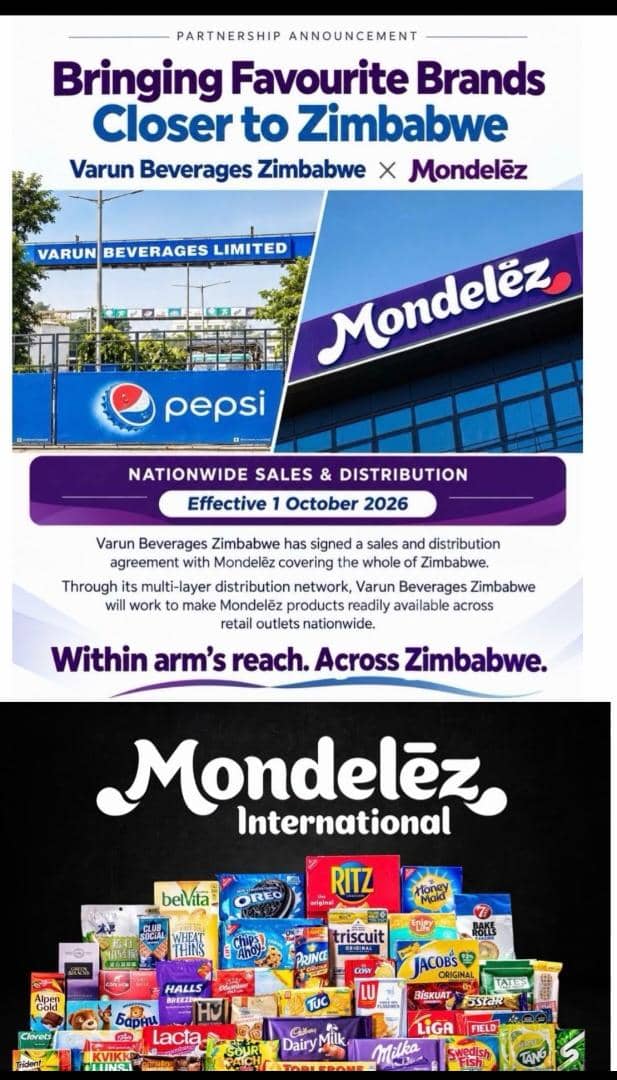
Mondelēz International’s South African arm has signed an exclusive, nationwide sales and distribution agreement with Varun Beverages Zimbabwe, handing the Indian-owned beverages and snacks group the right to move the American confectionery giant’s entire local portfolio — Cadbury, Oreo, Toblerone, belVita, Milka, Ritz, Trident and the rest — through every retail tier in the country. The agreement takes effect on 1 October 2026, under the banner “Bringing Favourite Brands Closer to Zimbabwe.”

It is a short sentence with long consequences. This is not simply a new product line for Varun. It is a transfer of one of the world’s largest confectionery portfolios out of the hands of the distributors who built its Zimbabwean footprint, and into the fleet of a company that, until 2018, was known here purely as PepsiCo’s bottler.
The Mechanics of the Deal
The structure is straightforward. Mondelēz keeps manufacturing and brand ownership; Varun Beverages Zimbabwe takes over sales, warehousing and last-mile delivery for the whole country, across chocolates, biscuits and cookies, candies and sweets, and chewing gum.
For Mondelēz, this converts a fixed manufacturing relationship into a variable-cost distribution arrangement — it pays for shelf reach without owning a single truck. For Varun, it is the second major branded-goods mandate to land in its lap in barely two years, after PepsiCo appointed it exclusive distributor of Lay’s, Doritos and Simba snacks in 2024.
The logic is almost too neat. Varun did not need to build anything to win this contract. It already had the trucks.
Why Varun, Why Now
Varun Beverages Zimbabwe entered the market in 2018 as a Pepsi bottler with a single production line. Eight years on, it runs six production lines producing close to 100 million bottles a month, deploys nearly 400 trucks daily, and reaches retailers from Pick n Pay and Spar down to rural general dealers and tuck shops, with its portfolio available across major B2C and B2B outlets including Pick n Pay, Spar, N Richards, Gain, Metro and Mega Save. That is precisely the kind of multi-layer network a confectionery principal needs if it wants its Oreos in a Mbare tuck shop, not just a Borrowdale supermarket.
Varun’s own management has been candid about the timing. The company has pointed to Zimbabwe’s improving currency stability as a reason the country is now attracting fresh FMCG investment, describing the evolving economic environment and improving currency stability as factors creating new investment opportunities across the sector, especially in beverages.
That is not idle optimism. Zimbabwe’s gold-backed ZiG currency has just delivered its first sustained run of single-digit domestic inflation since 1997, with annual ZiG inflation falling to 4.1% in January 2026 and the finance ministry calling it a critical milestone toward durable macroeconomic stability, while the economy is projected to grow by roughly 5% in 2026 on the back of agriculture and mining, a rebound underpinned by growing foreign reserves backing the ZiG. When the currency stops eating your margin, you start signing distribution contracts instead of merely defending market share. This is Varun reading that signal and moving first.
There is also raw scale behind the confidence. Chairman Ravi Jaipuria has already committed the group to a five-year, $650 million investment roadmap for Zimbabwe covering snacks, a PET recycling plant, the Carlsberg brewery joint venture and up to a gigawatt of renewable energy capacity, a plan the company frames around Zimbabwe’s place as one of the most important markets in its African expansion strategy. Mondelēz’s confectionery lines slot into an infrastructure that was already being built for something else. Zero incremental capital expenditure, in other words, for a company that was never short of capital ambition.
What It Means for the Economy
Officially, this is framed as an efficiency story: one delivery truck now carrying Pepsi, Cheetos and Cadbury to the same shop in one drop, instead of three separate suppliers making three separate trips. That consolidation genuinely lowers the cost of reaching Zimbabwe’s retail base, particularly the informal and rural tiers that formal FMCG has always struggled to serve profitably.
But the deeper economic story is about formalisation and capital deepening. Varun’s expansion has already generated meaningful local employment — the company puts the figure at roughly 2,000 direct jobs and more than 13,000 indirect livelihoods across logistics, retail and farming linked to its Harare operations. Every new principal it wins adds volume to that same backbone rather than duplicating it, which is a more capital-efficient form of industrial growth than each multinational building its own parallel network.
It also sits neatly inside government’s import-substitution agenda. Varun’s snack localisation strategy has been explicitly tied to increased maize sourcing from Zimbabwean farmers, a linkage authorities have welcomed as strengthening ties between manufacturing and agriculture. Distribution deals do not carry the same manufacturing-linkage story as a new factory, but they do formalise more of Mondelēz’s trade through tax-compliant, audited channels rather than informal cross-border imports — a point that should matter to a fiscus trying to widen its net without raising rates.
For capital markets watchers, there is a further angle. Axia Corporation, the ZSE-listed parent of Distribution Group Africa, has just reported a resilient set of numbers, with DGA’s Zimbabwean operation growing revenue by 44% on a like-for-like basis even amid currency headwinds. Whether this specific mandate change shows up in Axia’s next results announcement is worth watching for anyone tracking counter movements on the exchange — a material principal loss for a listed distribution business is exactly the kind of disclosure item analysts probe for in interim reports.
What It Means for Consumers
For the ordinary shopper, the promise is availability, not novelty. The campaign’s own tagline — “within arm’s reach across Zimbabwe” — is a distribution promise, not a marketing flourish. Cadbury already sits as the most-scanned confectionery brand in the Zimbabwean market, out of the 99 brands and 361 products tracked in the category. The brand equity was never the problem; getting the product to a shelf in Gokwe or Binga consistently was.
A single, well-capitalised distributor running daily rural routes should mean fewer stock-outs and more consistent pricing than a fragmented import-based supply chain historically delivered. Whether it also means cheaper Cadbury bars is a separate question — logistics consolidation lowers cost-to-serve, but Mondelēz still sets its own price architecture. Consumers should expect better shelf presence before they expect a discount.
The Competitive Fallout: Axia, DGA and the Old Guard
This is where the deal turns from a logistics footnote into a genuine market disruption. Distribution Group Africa has, for a generation, been Zimbabwe’s dominant channel for global consumer-goods principals — its portfolio has spanned Colgate, Kellogg’s, Johnson & Johnson, Tiger Brands, Unilever, Rhodes, Pioneer, Irvines and Probrands, built through DGA’s expertise in bonded warehousing, cold-chain logistics and nationwide merchandising.
Losing a marquee global confectionery house — with its accompanying volume, margin and shelf-power — is precisely the kind of principal churn that erodes a distributor’s bargaining position with retailers over time, even if the immediate revenue hit is cushioned by the rest of a broad portfolio.
It is not, however, a knockout blow. DGA remains one of only two or three operators in Zimbabwe capable of running the kind of nationwide, multi-temperature distribution network that global principals demand, and its recent numbers show an operation still capable of double-digit growth against informal-market pressure. The bigger strategic question for Axia’s board is whether this is an isolated loss or the first domino — whether other multinational principals now look at Varun’s expanding truck fleet and wonder if it, rather than DGA, is the more efficient route to Zimbabwean shelves.
Principal concentration risk cuts both ways: it is a growing threat for the incumbent distributor and a growing asset for Varun, whose bargaining power in future negotiations with global brand owners only strengthens with each mandate it adds.
Innscor Africa, meanwhile, faces a different kind of pressure — competitive rather than logistical. Its Probrands biscuit business and its Zapsnacks line, which has been growing volumes strongly, compete directly with Oreo, Ritz and belVita on the same shelf, not for the same delivery slot. National Foods’ King Kurls brand, a runner-up for Leading Snacks Brand at the 2026 Zim Brands Awards, sits in the same category.
A more efficiently distributed Mondelēz portfolio, reaching further into rural and peri-urban outlets than before, raises the competitive bar for locally manufactured snacks precisely in the markets where they have historically had the advantage of superior reach.
Reshaping Zimbabwe’s Snacks and FMCG Map
Step back, and a pattern emerges. Zimbabwe’s snacks and FMCG market is consolidating around distribution infrastructure rather than around brand ownership. Varun now runs the truck fleet for two of the three largest snacking and confectionery houses on earth — PepsiCo and Mondelēz — inside a single national market of barely sixteen million people, alongside its own beverage and locally manufactured snack lines.
That is an unusual degree of channel concentration for a market this size, and it changes the unit economics of entry for the next multinational eyeing Zimbabwe. Why build a distribution relationship with three different partners when one company can already put your product in a Pick n Pay and a rural tuck shop on the same route sheet?
The Zimbabwean snacks market, estimated by Varun itself at roughly $177 million a year as of 2024, is not large by global standards, but it is exactly the size where distribution efficiency, not manufacturing scale, decides who wins shelf space. Whoever controls the truck controls the market conversation with retailers — increasingly, in Zimbabwe, that is Varun.
Other Insights Worth Watching
Three things merit continued attention. First, this is not a Zimbabwe-only story — Varun has been assembling a similar playbook of exclusive multinational distribution mandates across its African footprint, from its PepsiCo snacks agreements in Zambia and Morocco to its 2026 acquisition of South Africa’s Twizza and its BevCo bottling operation across South Africa, Lesotho, Eswatini, Botswana and Namibia.
Zimbabwe looks less like a one-off deal and more like a template Varun intends to repeat wherever it already owns beverage infrastructure.
Second, watch DGA’s next set of interim results for any explicit reference to principal changes — under ZSE and VFEX disclosure norms, a material contract loss of this nature would typically warrant investor commentary, even if softened by other portfolio growth.
Third, there is a quieter industrial-policy irony here. Government has spent several years courting import substitution and local manufacturing. This deal delivers neither — it is Zimbabwean shelves getting more efficient access to imported and regionally manufactured global brands, not new local factories. The genuine manufacturing story remains Varun’s own snack and beverage lines, not this distribution mandate. Policymakers celebrating “Bringing Favourite Brands Closer to Zimbabwe” should be honest about which parts of that headline are industrial development, and which are simply better logistics.
Either way, from 1 October, the question retailers will be asking is not who makes the chocolate. It’s whose truck brought it.
Jabulani Simplisio Chibaya is a Data and AI Consultant specializing in data science, artificial intelligence, blockchain, and cryptocurrency innovation. A seasoned conference speaker, he also writes on the intersection of technology, regulation, and economic development. Contact: Cell: +263 778 921 881 | Email: simplisiochibaya22@gmail.com | LinkedIn: https://www.linkedin.com/in/jabulani-simplisio-chibaya
Discover more from Etimes
Subscribe to get the latest posts sent to your email.