


By Jabulani Simplisio Chibaya
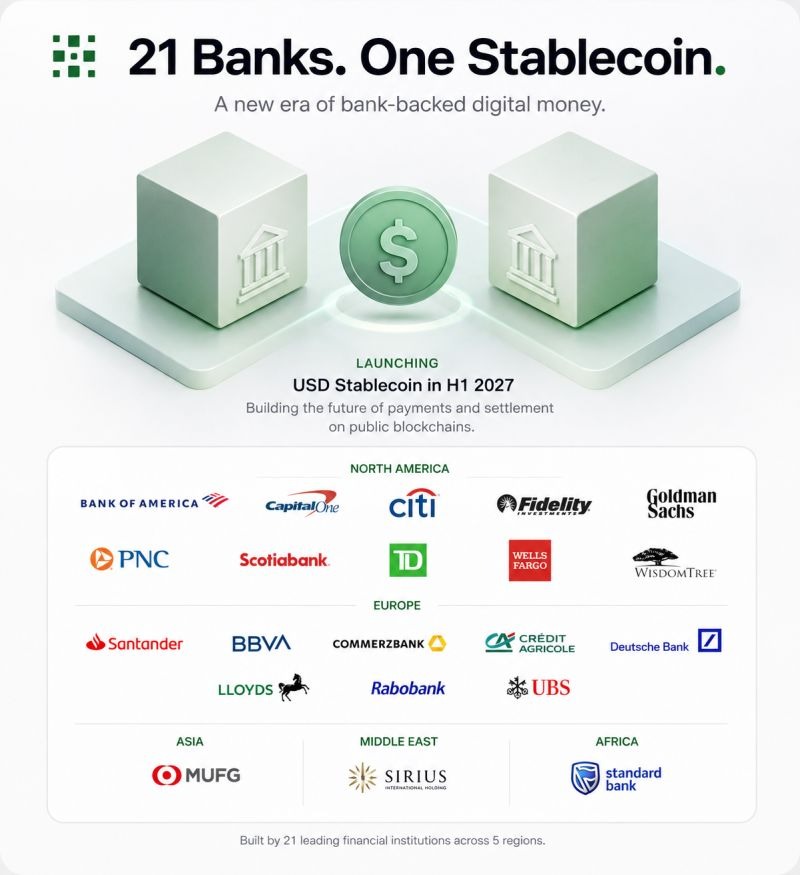
HARARE – IN early September 2026, a quiet but consequential announcement rippled through global finance. Twenty-one leading financial institutions—spanning Bank of America, Citi, Goldman Sachs, Wells Fargo, Deutsche Bank, UBS, Santander, BBVA, MUFG, and notably Standard Bank from Africa—committed to establishing a new company in the second half of 2026. Their goal: to issue a regulated, 1:1 reserve-backed U.S. dollar stablecoin, targeted for market release in the first half of 2027, with ambitions to expand into other G7 currencies, starting with the euro.
This is not another experimental crypto pilot. The consortium, grown from an initial group of ten banks exploring public-blockchain digital money in late 2025, emphasizes bank-grade compliance, governance, distribution, and risk management. It aims for alignment with the U.S. GENIUS Act and the EU’s MiCA framework. Use cases explicitly include wholesale, institutional, and retail payments, cross-border transfers, and digital asset settlement.

For traditional finance, this marks a strategic pivot from defense to offense. Banks have watched Tether and Circle dominate the multi-hundred-billion-dollar stablecoin market. Now they are building their own trusted alternative on public blockchains, while some parallel efforts focus on tokenized deposits to protect existing deposit bases. The absence of JPMorgan from this particular group underscores that different institutions are pursuing complementary or competing paths. Yet the inclusion of Standard Bank signals something important for the Global South: Africa is not an afterthought.
The African Context: High Costs, High Stakes
Nowhere is the potential more tangible than in Africa, where remittances form a critical economic backbone and traditional banking remains expensive and incomplete. Sub-Saharan Africa consistently ranks among the costliest regions in the world for receiving remittances. Average fees for sending $200 have hovered well above global averages—often in the 7–9% range or higher on certain corridors—due to layered correspondent banking, FX spreads, and intermediary charges. Settlement can take days, capital sits locked, and transparency is limited.
In Zimbabwe, the stakes feel especially acute. Diaspora remittances provide essential foreign currency inflows that support households, education, healthcare, and small businesses amid a history of currency volatility and constrained formal banking access. Traditional channels involve money transfer operators, banks, and authorized dealers operating under Reserve Bank of Zimbabwe guidelines. These systems work, but friction persists: high fees erode value, delays create hardship, and limited competition keeps costs elevated. Informal networks sometimes fill gaps, carrying their own risks.
Across the continent, mobile money has already demonstrated Africa’s capacity to leapfrog traditional infrastructure. M-Pesa and similar platforms brought basic financial services to hundreds of millions without requiring full bank branches. Stablecoins offer a parallel opportunity at the international layer—particularly dollar-denominated ones that provide a stable unit of account in environments where local currencies face inflationary pressure.
Where the Opportunities Lie
A bank-issued, regulated USD stablecoin from a consortium that includes a major African player opens several concrete pathways.
Dramatically cheaper and faster remittances. Stablecoin transfers can settle in seconds or minutes at fractions of a percent in network fees, compared with multi-day SWIFT-style rails and high percentage charges. For a Zimbabwean family receiving support from the UK, South Africa, or the United States, the difference between losing 8–15% in fees versus under 1–2% (plus transparent off-ramp costs) is transformative. Recipients need not even hold the stablecoin themselves; fintechs, mobile money operators, and banks can handle conversion into local currency or mobile wallets at the last mile. Existing pilots and partnerships already show this model working in parts of Africa, with stablecoins acting as the wholesale settlement layer while fiat remains the retail experience.
Cross-border trade and SME payments. African businesses importing goods or settling with suppliers in China, the Middle East, Europe, or neighboring countries face the same correspondent banking bottlenecks. A trusted bank stablecoin enables near-instant, low-cost settlement 24/7. Standard Bank’s participation could help bridge local rails—South African and broader African payment systems—with the new digital dollar, reducing the need for multiple FX conversions and intermediary banks.
Treasury management and inflation hedging. Corporations, NGOs, and even individuals in high-inflation or volatile-currency environments can hold or transact in a regulated digital dollar without relying solely on physical cash or limited formal foreign currency accounts. For Zimbabwean exporters, diaspora businesses, or regional traders, this provides a more efficient store of value and medium of exchange that sits within a compliant banking framework rather than purely crypto-native platforms.
Financial inclusion and product innovation. With more than half of adults in parts of sub-Saharan Africa still outside traditional bank accounts, yet high mobile penetration, banks and fintechs can use stablecoin rails as an on-ramp. Local banks could offer seamless conversion between the consortium’s token, mobile money, and local currency. Asset managers in the consortium (Fidelity, WisdomTree) suggest potential for tokenized products or yield-bearing structures that could eventually reach African savers in regulated form. Partnerships already emerging—such as those involving major stablecoin issuers and African technology groups—illustrate demand for better digital dollar infrastructure.
Leapfrogging legacy banking costs. African banks have long operated under high operational and compliance costs for cross-border activity. By integrating a consortium stablecoin, they can participate in a global network with shared standards for compliance and risk management rather than building everything from scratch. This mirrors how mobile money allowed leapfrogging of branch networks. Regulated stablecoins can complement central bank digital currency explorations and domestic instant payment systems without replacing them. Mukuru Zimbabwe CEO Doug Tait shared similar sentiments at the Zimswitch Payments Conference 2026 in Victoria Falls, emphasizing that stablecoins will help the nation leapfrog in the same way USDT has enabled leapfrogging of legacy banking systems in Nigeria.
Practical Pathways for Zimbabwean and African Banks
For banks in Zimbabwe and across Africa, the opportunity is not necessarily to issue competing stablecoins immediately but to become critical nodes in the distribution and settlement ecosystem. Standard Bank’s presence in the 21-member group provides a natural bridge. Local institutions can:
- Partner for on- and off-ramps, converting the bank stablecoin into ZWG, rand, naira, cedi, or mobile money balances.
- Serve as liquidity providers and authorized dealers under existing foreign exchange frameworks, ensuring compliance with local regulations on remittances and free funds.
- Offer customer-facing products: remittance apps that settle via the stablecoin rail but deliver local currency; business accounts with instant international payouts; or treasury tools for holding digital dollars.
- Collaborate with fintechs already active in stablecoin corridors to extend reach while retaining the trust and regulatory relationships that banks uniquely hold.
Regulatory clarity will be essential. African central banks and the Reserve Bank of Zimbabwe will need frameworks that allow innovation while managing capital flow, AML/CFT, consumer protection, and monetary sovereignty risks. The consortium’s emphasis on GENIUS Act and MiCA compliance offers a template that local regulators can engage with constructively. Experience from other emerging markets shows that clear rules accelerate responsible adoption rather than hinder it.
Challenges and Realistic Outlook
Success is not guaranteed. Adoption depends on choosing accessible blockchains, achieving genuine interoperability, managing reserves transparently, and competing with established private stablecoins that already enjoy network effects. Local infrastructure, internet reliability, digital literacy, and last-mile conversion costs matter. Currency controls and foreign exchange regulations in countries like Zimbabwe require careful navigation so that stablecoin use enhances rather than circumvents policy goals.
Competition is intensifying. Other consortia and private issuers are active. Card networks and specialized payment firms are integrating stablecoin settlement. Yet the credibility, distribution reach, and regulatory alignment of major banks give this group a distinctive advantage—particularly for institutions and larger flows that prioritize safety and compliance.
A Leap Worth Taking
The 21-bank initiative arrives at a moment when Africa’s digital finance foundations are already strong. Mobile money proved that populations will adopt tools that solve real problems of cost, speed, and access. A regulated, bank-backed dollar stablecoin—especially one involving an African institution—can extend that leap to the international layer.
For Zimbabwean families waiting on remittances, for traders moving goods across borders, for banks seeking to modernize without losing relevance, and for the broader African economy seeking efficient integration into global finance, the potential is substantial. Lower fees mean more money stays in households. Faster settlement means businesses can operate more fluidly. Trusted digital dollars mean greater resilience in uncertain monetary environments.
The company is still to be named, the token still to be launched, and the precise technical and commercial details still to be finalized. But the direction is clear: traditional banks are no longer content to watch digital money evolve around them. By building it themselves—and including African representation from the start—they create an opening for the continent’s financial institutions to move from the periphery of correspondent banking to the center of a more efficient, inclusive global payment system. The leap from expensive, slow remittances and fragmented banking to near-instant, low-cost digital dollars is no longer theoretical. With thoughtful regulation, partnerships, and execution, African banks and the customers they serve can capture it.
Jabulani Simplisio Chibaya is a Data and AI Consultant specializing in data science, artificial intelligence, blockchain, and cryptocurrency innovation. A seasoned conference speaker, he also writes on the intersection of technology, regulation, and economic development. Contact: Cell: +263 778 921 881 | Email: simplisiochibaya22@gmail.com | LinkedIn: https://www.linkedin.com/in/jabulani-simplisio-chibaya
Discover more from Etimes
Subscribe to get the latest posts sent to your email.