


By Jabulani Simplisio Chibaya
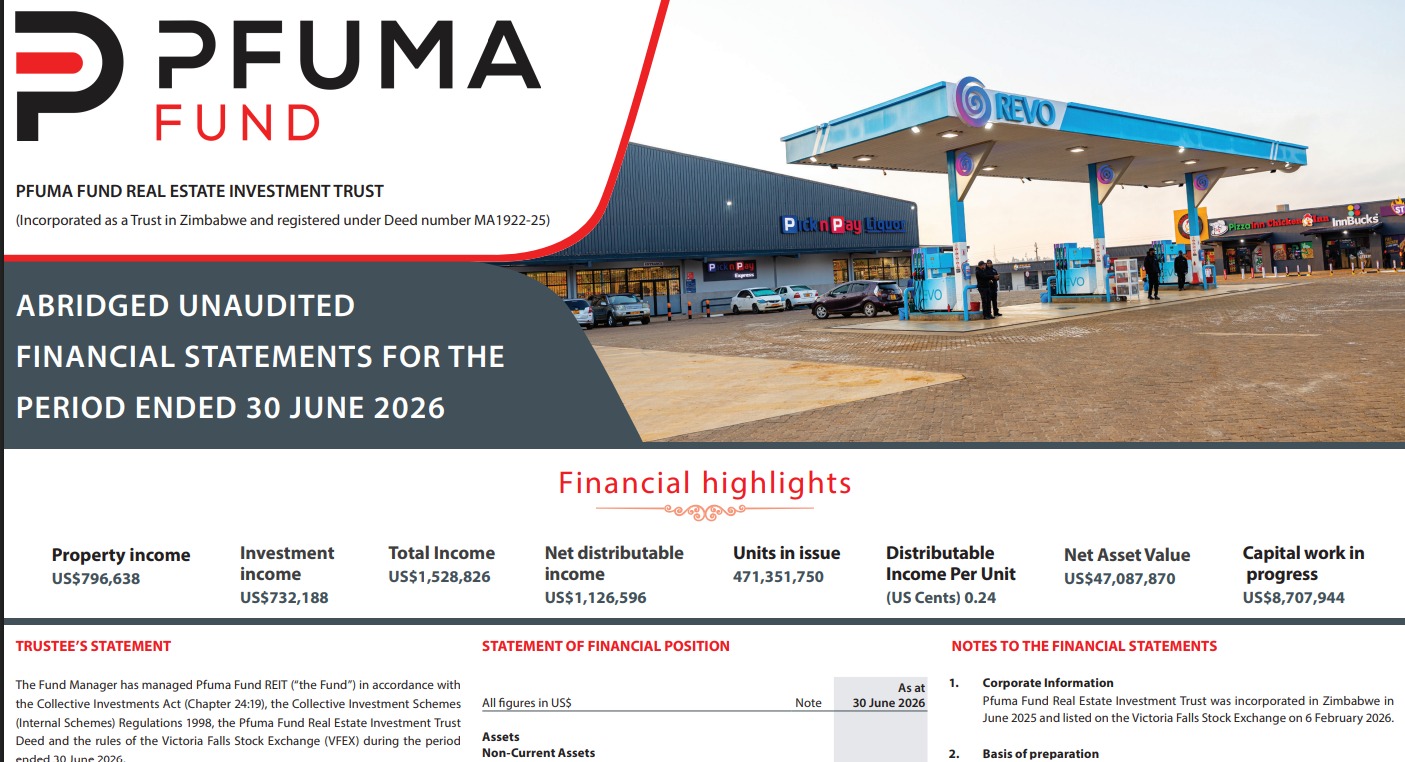
HARARE – PFUMA Fund Real Estate Investment Trust, listed on the Victoria Falls Stock Exchange in early February 2026, has released its first set of abridged unaudited half-year results for the period ended 30 June 2026. In a market still navigating currency dualism, inflation dynamics and selective capital formation, these numbers offer an early window into a hybrid REIT model that combines income-generating retail assets with a deliberate development pipeline. This analysis translates the figures for everyday investors, assesses business health, benchmarks performance against peers such as Tigere and Eagle, examines what lies beneath the headlines, and outlines practical recommendations.
What the Headline Numbers Mean for Ordinary Investors

Start with the big picture. At 30 June 2026, Pfuma reported total assets of US$47.19 million and net asset value (NAV) attributable to unit holders of US$47.09 million. With 471.35 million units in issue, that equates to a NAV per unit of roughly 10 US cents — essentially flat against the original listing and seed price of 10 cents. Total income for the half-year reached US$1.53 million, split between property (rental) income of US$796,638 and investment income of US$732,188. After operating expenses of US$402,230, the fund generated net distributable income of US$1.13 million, or 0.24 US cents per unit.
For a layperson, this is straightforward: the trust owns shopping centres and related assets that collect rent in US dollars, parks surplus cash in money-market instruments that also earn dollars, and pays out most of the residual profit as cash dividends. It has already declared two quarterly dividends — US$446,719 (0.0948 cents per unit) for the short inaugural period to 31 March and a further US$623,548 (0.132 cents per unit) for the second quarter — representing 95% of distributable income each time. Cumulative distributions total US$1.07 million, or 0.227 cents per unit. Annualising the half-year distributable income suggests a run-rate yield in the low-to-mid single digits on the original capital, consistent with management’s stated target of around 5% once the portfolio is fully deployed.
Occupancy stands at a healthy 98.7%. Only 203 m² remains vacant at Hogerty Hill out of a total gross lettable area of 16,107 m². That means almost every square metre is producing rent. Capital work-in-progress of US$8.71 million shows money already at work on future assets, while a further US$12.72 million sits in money-market investments waiting to be deployed.
Assets Owned and Purchased So Far
The seed portfolio consists of two retail centres. Hogerty Hill, the larger asset, is valued at approximately US$19.49 million and contributed US$578,363 in rent for the half-year, implying a gross yield of about 7.1%. Chegutu Retail Centre, valued at US$3.67 million, delivered US$218,275 and a higher implied gross yield of nearly 11.9%. Combined, the income-producing investment property stands at US$23.16 million (up from the original seed valuation of US$22.1 million after acquisition-related costs).
Post-balance-sheet, the fund completed the acquisition of the Cork Road property — a fully tenanted quick-service and casual-dining centre occupied by a leading brand. Consideration was settled by issuing 69.4 million new units, lifting total units in issue to 540.75 million. Development pipeline assets already capitalised include Kwekwe (US$2.14 million), Chivhu (US$1.84 million), Powai/Ruwa (US$4.0 million), Enterprise (US$0.05 million) and early Cork Road costs (US$0.68 million). Management targets completion of Kwekwe and one Chivhu project in Q4 2026, the second Chivhu tranche in Q1 2027 and Enterprise in Q2 2027. The stated five-year ambition is a portfolio approaching US$100 million.
Health of the Business and Key Metrics
Balance-sheet strength is the standout feature. Liabilities total only US$102,345 — essentially trade payables — against almost US$47 million of equity. There is no interest-bearing debt. Cash and cash equivalents closed at US$1.30 million, with a further US$12.72 million in money-market instruments providing liquidity and interim yield. Trade receivables of US$1.30 million are dominated by a VAT refund of US$1.04 million rather than tenant arrears, which appear modest at US$248,380.
Income quality is mixed in the short term. Property income is solid and growing, but investment income from the capital raise still accounts for nearly half of total revenue. As funds are deployed into developments and the Cork Road asset begins contributing, the mix should shift toward pure rental. Operating expenses of US$402,230 include asset-management fees (US$116,701), property management (US$55,765) and administration costs (US$229,764). The expense ratio relative to total income is elevated in this early phase — typical for a newly listed vehicle still absorbing listing and set-up costs — but should decline as scale increases.
Implied portfolio gross yield on the completed investment properties is approximately 7.9%. Net distributable income after costs equates to a more modest current yield, which will rise once vacancy is eliminated, escalations kick in and new assets come on stream. The 95% payout ratio demonstrates discipline and alignment with the hybrid-REIT mandate of returning cash while still funding growth.
Performance So Far and Comparison with Tigere and Eagle
Pfuma’s track record is measured in months rather than years. Listing occurred on 6 February 2026 after a fully subscribed US$25 million private placement that, together with seed assets, created an initial capital base of roughly US$47 million. Within weeks it was paying dividends — a rare feat that signals operational readiness of the seed assets and disciplined cash management.
Tigere Property Fund REIT, listed on the Zimbabwe Stock Exchange since late 2022, remains the most mature peer. For the full year 2025, it reported rental revenue of about US$2.64 million, net property income of US$2.73 million and total comprehensive income of US$2.68 million — nearly double the prior year. Investment property reached US$58.4 million and NAV approximately US$59.5 million. Occupancy hovered around 97%. Distributable income per unit rose 23% and dividends 28%. Tigere’s scale, longer operating history and proven ability to execute yield-accretive acquisitions give it a clear edge in absolute income generation and track record. However, it trades on the ZSE and therefore carries residual local-currency considerations for pure-USD investors.
Eagle REIT, the first VFEX-listed property vehicle (mid-2025), is more development-oriented with a tourism and hospitality focus. Its 2025 results showed investment property rising 57% to roughly US$31.5 million and total assets growing 65% to about US$39.5 million, with NAV around US$30 million. Early 2026 figures indicated a sharp jump in profitability once Mazowe Walk opened at high occupancy. Eagle’s strategy emphasises capital appreciation through development rather than immediate high cash yields, making it complementary rather than identical to Pfuma’s hybrid model.
Pfuma sits between the two: more income-focused than Eagle at this stage, smaller and younger than Tigere, but fully USD-denominated on the VFEX like Eagle. Its current NAV is already larger than Eagle’s latest reported figure and not far behind Tigere’s, reflecting the size of the capital raise. Occupancy is comparable to or better than both peers. Dividend policy is aggressive (95% versus the regulatory minimum of 80%), which is attractive for income seekers but leaves less retained capital for growth than a more conservative payout might.
What Lies Beneath the Numbers
Several subtler points merit attention. First, the heavy reliance on investment income in the half-year is temporary and intentional — a bridge while capital is deployed. Once the US$8.7 million of work-in-progress and remaining cash convert into income-producing assets, the quality of earnings should improve. Second, the Cork Road acquisition settled entirely in units avoids cash outflow but dilutes existing holders; the long-term value depends on the asset’s yield and growth relative to the issue price. Third, the development pipeline is concentrated in secondary cities (Kwekwe, Chivhu) and emerging nodes. These locations can deliver higher yields and capital growth if urbanisation and infrastructure continue, but they also carry higher execution and tenant-demand risk than established Harare retail.
Fourth, the absence of debt is both a strength and a constraint. It keeps risk low and distributions clean, yet limits the ability to lever returns in a rising-property-value environment. Fifth, the VAT receivable of over US$1 million is a non-earning asset that will eventually convert to cash, providing a one-off liquidity boost. Finally, the fund’s hybrid model — cash yields today, development upside tomorrow — is deliberately designed for Zimbabwe’s still-immature capital markets, where pure income REITs can struggle to scale and pure development vehicles can starve investors of interim returns.
Future Outlook
Management’s guidance points to completion of several pipeline projects through 2027 and a longer-term target of US$100 million in assets. With low single-digit USD inflation, stable exchange-rate conditions and continued demand for formal retail space, the operating environment is supportive. Successful delivery of the developments on time and budget, followed by leasing at the underwritten yields, should lift both absolute distributable income and NAV per unit. The addition of Cork Road already expands the income base. Risks include construction delays or cost overruns, slower-than-expected leasing in secondary towns, and any broader macroeconomic shock that reduces consumer spending power. Liquidity on the VFEX remains thinner than on the ZSE, so unit-price discovery can be volatile even when fundamentals are solid.
Recommendations for Retail and Institutional Investors
For retail investors seeking USD income with moderate growth, Pfuma offers an accessible entry point (original minimum was effectively US$100) and a transparent, high-payout policy. The combination of near-full occupancy, zero debt and visible development catalysts is attractive. Position sizing should reflect the early-stage nature of the vehicle and limited secondary-market liquidity; treat it as a satellite holding within a broader property or alternative-income allocation rather than a core position. Reinvest dividends if the goal is compounding; take them in cash if current income is the priority.
Institutional investors — pension funds, insurers and family offices — will focus on scale, governance and alignment. Pfuma’s pure-USD structure and VFEX listing remove currency friction. The aggressive distribution policy supports liability matching, while the development pipeline offers the possibility of NAV accretion beyond pure rental growth. Due diligence should emphasise the asset manager’s track record in delivering projects, tenant credit quality (especially in secondary locations), and the independence of valuations. Relative to Tigere, Pfuma provides cleaner currency exposure and a more explicit growth mandate; relative to Eagle, it offers higher near-term cash yield. A measured allocation that complements existing retail or hospitality exposure makes sense, with monitoring of deployment progress and occupancy trends as key milestones.
Hidden Insights and Closing Perspective
One under-appreciated strength is the speed of capital recycling: listing, first dividend and second-quarter distribution all occurred inside six months. Another is the deliberate seeding with cash-generative assets that allowed distributions from day one — a design choice that differentiates Pfuma from pure development plays. Conversely, the still-high proportion of non-rental income and the concentration of development risk in a handful of secondary-city projects are the principal watch-points.
Overall, the half-year numbers portray a conservatively capitalised, operationally competent young REIT that has already begun returning capital to unitholders while positioning for scale. It is neither the cheapest nor the most proven vehicle in the Zimbabwean REIT universe, but it is one of the cleanest expressions of USD retail property exposure currently available. For investors who understand that early-stage hybrid REITs deliver returns through a combination of yield, development profit and gradual re-rating, Pfuma merits close attention as its pipeline converts into rent-paying bricks and mortar.
Jabulani Simplisio Chibaya is a Data and AI Consultant specializing in data science, artificial intelligence, blockchain, and cryptocurrency innovation. A seasoned conference speaker, he also writes on the intersection of technology, regulation, and economic development. Contact: Cell: +263 778 921 881 | Email: simplisiochibaya22@gmail.com | LinkedIn: https://www.linkedin.com/in/jabulani-simplisio-chibaya
Discover more from Etimes
Subscribe to get the latest posts sent to your email.